
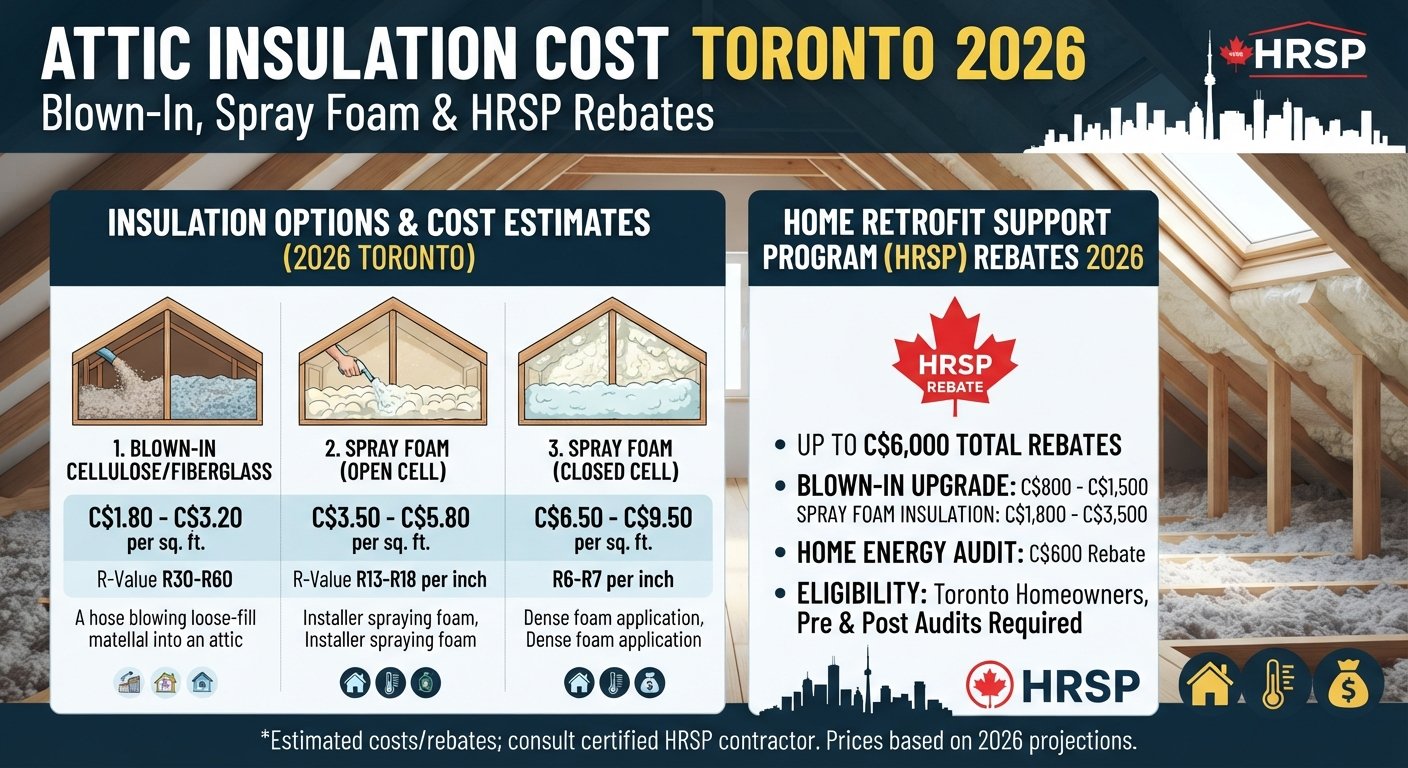
September in Toronto is the annual reminder: winter is three weeks away. The leaves are turning, the furnace is about to come on for the first time since April, and any gap in your home’s thermal envelope is about to start costing you money — every day, for the next six months.
Attic insulation is the single most cost-effective energy upgrade for most Toronto homes.Upgrading attic insulation to R-60 saves 20–40% on heating costs for most Toronto homes. For a typical Toronto home spending $2,400–$3,200 per year on natural gas, that’s $480–$1,280 in annual savings — from one renovation that also qualifies for Ontario’s largest active energy rebate.
Most pre-2000 Toronto homes have R-12 to R-28 in their attics — far below the R-50 Ontario Building Code minimum and further still from the R-60 target that maximizes both comfort and rebate eligibility. Fall is the perfect time to close that gap: attic conditions are ideal for installation, contractor availability is better than summer, and the insulation is working from day one of the heating season.
At David Reno, attic insulation is a core part of our home envelope improvement services. We coordinate the full project — from EnerGuide assessment booking through installation, inspection, and rebate documentation. This guide gives you real 2026 Toronto pricing across every insulation type, an honest blown-in vs. spray foam comparison, and the exact rebate amounts available right now.
Table of Contents
- Attic Insulation Cost Quick Reference — Toronto 2026
- Why Fall Is the Right Time — The Toronto Heating Season Window
- R-Value Guide: What Toronto Attics Actually Need
- Insulation Types & Cost Per Square Foot
- Blown-In vs. Spray Foam: The Honest Comparison
- Total Project Cost Examples
- Old Insulation Removal
- Ontario Rebates for Attic Insulation 2026
- Factors That Affect Your Total Cost
- Signs Your Attic Needs Insulation
- Air Sealing — The Step Most Contractors Skip
- Project Timeline
- How David Reno Can Help
- Tips to Save Money
- Frequently Asked Questions
Attic Insulation Cost Quick Reference — Toronto 2026
| Insulation Type | Cost per Sq. Ft. | 1,000 Sq. Ft. Attic | 1,500 Sq. Ft. Attic | Best For |
|---|---|---|---|---|
| Blown-In Cellulose | $1.00 – $1.80 | $1,000 – $1,800 | $1,500 – $2,700 | Standard attics, budget-conscious, eco-friendly |
| Blown-In Fiberglass | $0.80 – $1.50 | $800 – $1,500 | $1,200 – $2,250 | Standard attics, lowest cost option |
| Open-Cell Spray Foam | $1.50 – $3.50 | $1,500 – $3,500 | $2,250 – $5,250 | Air sealing + insulation combined, kneewall areas |
| Closed-Cell Spray Foam | $3.00 – $7.00 | $3,000 – $7,000 | $4,500 – $10,500 | Cathedral ceilings, maximum performance, moisture barrier |
| Batt (Fiberglass) | $1.00 – $2.50 | $1,000 – $2,500 | $1,500 – $3,750 | New construction, accessible open joist bays |
| Old insulation removal | $1.50 – $4.00 | $1,500 – $4,000 | $2,250 – $6,000 | Required before adding new insulation in many Toronto attics |
Why Fall Is the Right Time — The Toronto Heating Season Window
There’s a narrow but ideal window for attic insulation in Toronto: September through October. Here’s why it matters:
- Attic temperatures are moderate: Summer attics in Toronto reach 55–65°C — extreme heat that makes conditions uncomfortable for workers and affects spray foam curing. September attics are 20–28°C — optimal installation conditions.
- Insulation works from day one of heating season: Toronto’s heating season begins in earnest in November. Insulation installed in October is working for you from the first cold night — not retroactively improving an already-cold home.
- Better contractor availability: Summer is peak season. September and October offer better scheduling, and some contractors offer end-of-season pricing to fill their fall calendars before winter.
- Rebate processing before year-end: Starting the EnerGuide assessment process now means HRSP and Enbridge rebate applications can be submitted before the program’s November 30, 2026 deadline.
R-Value Guide: What Toronto Attics Actually Need
R-value measures a material’s resistance to heat flow — the higher the R-value, the better it insulates. Ontario Building Code SB-12 (updated January 1, 2026) sets the minimum attic insulation at R-50 for new construction, with blower-door airtightness now enforced at ≤ 2.5 ACH. But the recommended upgrade target for existing Toronto homes is R-60.
| Current R-Value | Typical Age of Toronto Home | Condition | Upgrade Target | HRSP Rebate Tier |
|---|---|---|---|---|
| R-12 or below | Pre-1960 | Critical — significant heat loss | R-60 | Maximum rebate ($7,700 HRSP) |
| R-12 to R-25 | 1960s – 1980s | Below code — common in GTA stock | R-60 | High rebate tier |
| R-25 to R-35 | 1980s – 2000s | Below current standard | R-50 to R-60 | Mid rebate tier |
| R-35 to R-50 | 2000s – 2015 | Approaching code minimum | Top-up to R-60 | Lower rebate tier |
| R-50+ | Post-2015 | At or above current minimum | Maintain | No upgrade needed |
The vast majority of Toronto’s housing stock — the 1960s–1990s bungalows in North York and Etobicoke, the semi-detached homes in East York and Scarborough — falls in the R-12 to R-28 range. That’s where the biggest energy savings are available, and where the HRSP rebate is highest.
Insulation Types & Cost Per Square Foot
Blown-In Insulation (Cellulose & Fiberglass) — $0.80 to $1.80/sq ft
Blown-in insulation is the most cost-effective attic insulation for most Toronto homes — and the type most installers will recommend for a standard accessible attic floor. Loose-fill material (cellulose or fiberglass) is machine-blown through a hose into the attic space, filling gaps and covering joists completely.
Cellulose vs. Fiberglass Blown-In
| Cellulose (recycled paper) | Fiberglass (loose-fill) | |
|---|---|---|
| Cost per sq ft (installed) | $1.00 – $1.80 | $0.80 – $1.50 |
| R-value per inch | R-3.7 | R-2.2 – R-2.7 |
| Inches needed for R-60 | ~16 inches | ~22 inches |
| Eco credentials | 75–85% recycled content | 20–30% recycled content |
| Moisture sensitivity | Absorbs moisture — can clump | Doesn’t absorb moisture |
| Settling over time | 10–20% over 10 years | Similar settling |
Pros: Lowest cost per R-value achieved, widely available, fast installation (a 1,000 sq ft attic can be done in 3–5 hours), HRSP rebate eligible, air seals between joists when blown properly.
Cons: Blown-in cellulose and fiberglass lose 10–20% of their R-value within a decade due to settling, and GTA freeze-thaw cycles accelerate that decline. Requires proper air sealing of ceiling penetrations before installation — otherwise insulation quantity alone won’t solve heat loss.
Best for: Standard accessible vented attics, budget-conscious projects, most Toronto semi-detached and bungalow renovations.
Open-Cell Spray Foam — $1.50 to $3.50/sq ft
Open-cell spray foam expands to a soft, spongy texture that fills gaps and provides both insulation and air sealing in one application. It’s less expensive than closed-cell but offers a lower R-value per inch (approximately R-3.5 per inch vs. R-6.5 for closed-cell).
R-value per inch: R-3.5
Inches needed for R-60: Approximately 17 inches
Best applications in Toronto attics:
- Kneewall areas where access is limited
- Cathedral ceiling sections where depth is constrained
- Edges and penetrations where air sealing is the primary goal
- Combination use: spray foam at the perimeter and penetrations, blown-in for the main attic floor
Pros: Excellent air sealing, expands to fill irregular gaps, single-step installation, doesn’t settle like blown-in.
Cons: Spray foam becomes expensive quickly at $3–$8/sq ft, so applying it everywhere without a plan can turn a normal upgrade into a wallet event with little extra comfort to show for it. Not the most cost-effective choice for a flat, standard attic floor where blown-in performs well.
Closed-Cell Spray Foam — $3.00 to $7.00/sq ft
Closed-cell spray foam is the highest-performance insulation product available — delivering R-6.5 per inch (the best R-value per inch of any product), a vapour barrier, and structural rigidity in a single application. It’s the right choice for specific challenging applications in Toronto attics.
R-value per inch: R-6.5
Inches needed for R-60: Approximately 9 inches
Best applications for Toronto homes:
- Sloped cathedral ceilings where depth is very limited
- Rim joists in basements (small area, big impact)
- Flat roofs on Toronto’s Victorian and Edwardian homes
- Any application where both insulation and vapour control are needed
Important note: Only CUFCA-certified contractors can submit the paperwork that proves the foam’s 6-month aging Lambda value meets CAN/ULC-S705.1 standards — required for Ontario rebate processing. Confirm your contractor holds CUFCA certification before proceeding with closed-cell foam.
Batt Insulation — $1.00 to $2.50/sq ft
Fiberglass or mineral wool batts are pre-cut panels installed between joists. They work well in new construction where joists are open and accessible, but are less practical for most Toronto retrofit attics where existing insulation, stored items, and limited access make precise fitting difficult.
Best for: New construction, accessible open joist bays with no existing insulation, garage ceilings, or very small retrofit areas.
For most Toronto attic retrofits, blown-in or spray foam is a more practical and cost-effective choice. Batts left with gaps or compression lose significant R-value — and achieving the consistent coverage needed for R-60 is very difficult in a typical Toronto attic.
Blown-In vs. Spray Foam: The Honest Comparison
| Blown-In (Cellulose/Fiberglass) | Spray Foam (Open or Closed Cell) | |
|---|---|---|
| Upfront cost (1,200 sq ft attic) | $960 – $2,160 | $1,800 – $8,400 |
| R-value per inch | R-2.2 – R-3.7 | R-3.5 (open) – R-6.5 (closed) |
| Air sealing | Partial (depends on preparation) | Excellent — self-sealing |
| Settling over time | 10–20% over 10 years | None — permanent |
| Moisture handling | Cellulose can absorb and clump | Closed-cell: full vapour barrier |
| Installation time | 3–5 hours (1,000 sq ft) | 1–4 hours (but cure time required) |
| HRSP rebate eligible | Yes | Yes |
| Best application | Standard flat vented attic floor | Cathedral ceilings, rim joists, penetrations, limited-depth areas |
| 20-year total cost | Higher if top-up required at year 10–12 | Higher upfront but no repeat cost |
The bottom line: For a standard vented attic floor, blown-in cellulose or fiberglass over a properly air-sealed ceiling is usually the more cost-effective way to reach a strong, consistent R-value, and it does so at a fraction of the price of foaming the whole attic. Spray foam excels in targeted applications — cathedral ceilings, rim joists, kneewall edges — where blown-in can’t achieve consistent coverage. A hybrid approach (spray foam at penetrations and edges, blown-in for the main field) often delivers the best performance-to-cost ratio for Toronto homes.
Total Project Cost Examples
Small Toronto Attic — 800 sq ft (Typical Semi-Detached, East York / Leslieville)
- Air sealing (ceiling penetrations, pot lights, partition walls): $400 – $700
- Blown-in cellulose to R-60 (800 sq ft): $800 – $1,440
- Ventilation baffles (if needed): $200 – $400
- Total (no removal): $1,400 – $2,540
- Add old insulation removal (if required): +$1,200 – $3,200
- After Ontario HRSP rebate (up to $7,700): Net cost as low as $0 – $1,000
Standard Toronto Attic — 1,200 sq ft (Detached, North York / Etobicoke)
- Air sealing (comprehensive): $600 – $1,000
- Blown-in cellulose to R-60 (1,200 sq ft): $1,200 – $2,160
- Spray foam at rim joists and kneewall edges: $400 – $800
- Ventilation baffles: $300 – $500
- Total (no removal): $2,500 – $4,460
- Add old insulation removal: +$1,800 – $4,800
- After HRSP rebate ($7,700 max) + Enbridge HER ($1,250): Net cost: $0 – $1,000 on many projects
Large Toronto Attic — 1,800 sq ft (Larger Detached, Scarborough / Markham)
- Air sealing (comprehensive): $800 – $1,400
- Blown-in cellulose to R-60 (1,800 sq ft): $1,800 – $3,240
- Spray foam at edges and penetrations: $600 – $1,200
- Old insulation removal (1,800 sq ft): $2,700 – $7,200
- Total: $5,900 – $13,040
- After HRSP ($7,700) + Enbridge HER ($1,250): Net cost: $0 – $4,090
Old Insulation Removal
Not every attic upgrade requires removing existing insulation. But when old insulation is damaged, contaminated, compressed below usable R-value, or infested, removal is necessary before new insulation is installed.
| Removal Scenario | Cost per Sq. Ft. | Notes |
|---|---|---|
| Standard blown-in removal (vacuum extraction) | $1.50 – $3.00 | Most common scenario in Toronto retrofits |
| Vermiculite removal (asbestos risk — pre-1990 homes) | $3.00 – $6.00+ | Abatement contractor required — testing first |
| Rodent or pest-contaminated insulation | $2.50 – $5.00+ | Biohazard handling and disposal required |
| Wet or mould-damaged insulation | $3.00 – $6.00+ | Mould assessment first; source of moisture must be resolved |
Ontario Rebates for Attic Insulation 2026
Ontario Home Renovation Savings Program (HRSP) ✅ ACTIVE
Up to $7,700 for attic insulation
Attic insulation qualifies for the largest single rebate in Ontario’s active energy efficiency program. The Enbridge Home Renovation Savings (HRS) rebate pays up to $1,250 when your attic is upgraded to R-50 or higher — no energy assessment required. The amount depends on your starting insulation: $1,250 (R-12 or below), $1,000 (above R-12 to R-25), or $800 (above R-25 to R-35). The program runs through November 30, 2026.
Two pathways to access HRSP attic rebates:
| Simple Pathway (Insulation Only) | Bundled Pathway (2+ Upgrades) | |
|---|---|---|
| Pre-assessment required? | No | Yes — EnerGuide audit before work |
| Maximum insulation rebate | Varies by R-value improvement | Up to $7,700 |
| Additional eligible upgrades | Windows only (at same time) | Windows, heat pump, doors, air sealing |
| Best for | Insulation-only projects | Homeowners doing multiple envelope upgrades |
How to apply: homerenovationsavings.ca — apply after installation for the simple pathway; complete the EnerGuide assessment before installation for the bundled pathway.
Enbridge Gas Home Efficiency Rebate (HER) ✅ ACTIVE
Up to $1,250 for attic insulation (Enbridge Gas customers only)
For GTA homeowners who heat with Enbridge Gas, this rebate stacks on top of the HRSP for additional savings. Amounts verified July 2026 at homerenovationsavings.ca.
- Starting at R-12 or below: $1,250 rebate when upgraded to R-50+
- Starting at R-12 to R-25: $1,000 rebate
- Starting at R-25 to R-35: $800 rebate
Requirements: Active Enbridge Gas account. Pre-retrofit EnerGuide home energy assessment before work begins. Minimum of two qualifying upgrades for the full HER program (insulation + one more).
How to apply: Through Enbridge Gas at enbridgegas.com/her — coordinate with your Registered Energy Advisor.
Stacking HRSP + Enbridge HER: Maximum Savings Example
For an Enbridge Gas customer upgrading a 1,200 sq ft Toronto attic from R-14 to R-60, plus replacing 15 windows at the same time:
- HRSP — Attic insulation (bundled): up to $7,700
- HRSP — Windows (15 × $100): $1,500
- Enbridge HER — Attic insulation (starting R-14): $1,250
- EnerGuide assessment rebate: $600
- Total rebates: $11,050
On a project that might cost $14,000–$18,000 total (attic + windows), these rebates reduce net cost to $3,000–$7,000 — and the project pays back through heating and cooling savings in 3–6 years.
Factors That Affect Your Total Cost
1. Attic Accessibility
A standard accessible attic with a proper hatch and clear floor area is fastest and cheapest to work in. Low-pitch attics (common in Toronto’s 1950s–1960s bungalows) with less than 24 inches of clearance require smaller equipment and more time — add 15–25% to blown-in labour. Knee-wall attics (split-level homes) require spray foam rather than blown-in in some sections.
2. Existing Insulation Condition
Existing insulation in good condition can be left in place and topped up — the most cost-effective scenario. Damaged, compressed, pest-contaminated, or moisture-affected insulation must be removed first — a significant additional cost. David Reno always inspects the existing condition before quoting to identify removal requirements.
3. Number of Ceiling Penetrations
Every pot light, plumbing stack, electrical box, and partition wall top plate in the ceiling below your attic is a potential air leak. Air sealing these penetrations before insulation is the highest-impact step in any attic insulation project — and the one most often skipped by cut-rate installers. Homes with many pot lights (a common feature in Toronto’s 1990s–2000s renovations) require more air sealing time and materials.
4. Attic Ventilation System
Proper attic ventilation (intake at soffits, exhaust at ridge or gable) must be maintained after insulation is added. Ventilation baffles (cardboard or foam channels installed against the roof deck at each rafter bay) ensure air flow isn’t blocked by new insulation. Budget $200–$600 for baffle installation depending on attic size and roof type.
5. Neighbourhood Location in GTA
Blown-in pricing is relatively flat across the GTA: $0.80–$1.20/sq ft fiberglass and $1.00–$1.50/sq ft cellulose regardless of postal code. Spray foam in downtown Toronto and the inner suburbs runs $4.50–$7.00/sq ft for closed-cell vs. $2.50–$4.50/sq ft in North York, Vaughan, Markham, and Brampton.
Signs Your Attic Needs Insulation
If you’re experiencing any of the following, your attic insulation is likely inadequate:
- Rooms that are hard to keep warm in winter or cool in summer — inconsistent temperature is often an envelope problem, not an HVAC problem
- Ice dams forming at the roof edge in winter — a classic sign of heat escaping through the attic, melting snow which refreezes at the eaves
- High natural gas bills that don’t match your usage patterns — heating bills should be predictable year over year; a sudden or gradual increase often traces back to insulation
- Frost forming on the inside of your attic hatch in winter — the hatch itself is often poorly insulated and a significant heat escape point
- Visible daylight in the attic around pot lights or pipe penetrations — these are air gaps, not just insulation gaps
- Your home was built before 2000 — virtually all pre-2000 Toronto homes have inadequate attic insulation by current standards
Air Sealing — The Step Most Contractors Skip
The most important thing your attic insulation contractor will do is not the insulation itself — it’s the air sealing that happens first.
Here’s why: insulation slows heat transfer through conduction. But heat also escapes through convection — warm air physically moving through gaps and penetrations into the cold attic. In most Toronto homes, these air gaps account for 25–40% of total heat loss. Piling more blown-in on top of an unsealed ceiling reduces some heat loss, but not all of it.
Critical air sealing points in a Toronto attic:
- Pot light housings (each one is a hole in your ceiling)
- Electrical box penetrations
- Partition wall top plates (the top of interior walls open into the attic in many older Toronto homes)
- Plumbing and duct penetrations
- Attic hatch (often completely unsealed — a significant heat escape)
- Exterior wall/ceiling intersections
Air sealing typically adds $400–$1,000 to a blown-in attic project. It’s the most cost-effective part of the job — and the step that separates contractors who deliver real energy savings from those who just add more insulation.
Project Timeline
| Phase | Duration | What Happens |
|---|---|---|
| Book EnerGuide assessment (if HRSP bundled) | 2 – 3 weeks lead time | Registered Energy Advisor visits; establishes pre-retrofit baseline |
| David Reno on-site estimate | 1 visit (1–2 hrs) | Attic inspection, existing R-value measurement, removal assessment, rebate confirmation |
| Old insulation removal (if needed) | 1 – 2 days | Vacuum extraction, bagging, Ministry-approved disposal |
| Air sealing | Half to 1 full day | All penetrations sealed with appropriate materials before insulation |
| Ventilation baffle installation | 2 – 4 hours | Baffles installed at each rafter bay along eaves |
| Insulation installation (blown-in) | 3 – 6 hours | Machine blown to target R-value; depth markers placed |
| Post-installation inspection | 1 – 2 hours | Depth and coverage check; documentation for rebate applications |
| Post-retrofit EnerGuide assessment (if bundled) | Schedule after installation | Confirms upgraded R-value; unlocks HRSP bundled rebate |
| Rebate applications submitted | 1 – 2 weeks after completion | HRSP and Enbridge HER applications submitted with documentation |
Total timeline: From first call to completed installation, allow 3–6 weeks. The EnerGuide assessment (if using the bundled HRSP pathway) has the longest lead time — book it first, this week.
How David Reno Can Help
Attic insulation is the home improvement project with the highest ratio of long-term return to upfront cost — and in fall 2026, active rebate programs can eliminate a large portion of that upfront cost for Toronto homeowners. David Reno handles the full scope:
- Free attic inspection and assessment: We inspect your existing insulation, measure current R-value, identify air sealing requirements, and check for removal needs — before quoting
- Rebate eligibility review: We confirm which HRSP and Enbridge HER rebate tiers apply to your starting R-value and project scope — at no charge
- EnerGuide assessment coordination: We connect you with a Registered Energy Advisor and schedule the pre-assessment to fit your project timeline
- Vermiculite screening: We identify any vermiculite or other hazardous materials before work begins and coordinate testing referrals
- Comprehensive air sealing: All accessible ceiling penetrations sealed before insulation — the step that creates real energy savings
- Ventilation baffle installation: Proper airflow at the eaves maintained throughout
- Blown-in or spray foam installation: To the target R-value specified in your project scope
- Rebate documentation: We provide all required project documentation for HRSP and Enbridge HER submissions
- Written warranty: All David Reno insulation work is warranted in writing
Tips to Save Money on Attic Insulation
1. Book Your EnerGuide Assessment This Week
The HRSP bundled pathway (up to $7,700) requires the EnerGuide assessment before work starts. With the program deadline at November 30, 2026, you need your assessment booked now. Waiting until October risks scheduling conflicts and missed deadlines.
2. Combine with Window Replacement for Maximum Rebates
Pairing attic insulation with window replacement in the same project unlocks the HRSP bundled pathway and adds $100 per Energy Star window to your total rebate. The same EnerGuide assessment covers both upgrades. See our Window Replacement Cost Guide for window pricing and rebate details.
3. Top-Up Before Removing (If Existing Is Clean)
If your existing insulation is in good condition (dry, uncontaminated, not vermiculite), topping it up to R-60 costs significantly less than a full removal and replacement. Have the existing condition inspected first — removal adds $1,500–$6,000 to the project and isn’t always necessary.
4. Book for September — Not October
September scheduling is easier, attic conditions are better than summer, and your project is complete before cold weather. October projects risk running up against the November 30 rebate deadline — and if an issue delays your project, there’s no buffer.
5. Address Pot Lights Before Insulating
If you have recessed pot lights and plan to add them or upgrade them in the next 1–2 years, do it before attic insulation. Installing new pot lights after the attic is insulated disturbs the insulation layer and requires air sealing to be redone.
Frequently Asked Questions
How much does attic insulation cost in Toronto in 2026?
Attic insulation in Toronto costs between $1.50 and $7.00 per square foot installed in 2026, depending on insulation type. For a typical 1,000 sq ft Toronto attic: blown-in cellulose or fiberglass costs $1,000–$2,700 for materials and labour; spray foam costs $2,500–$10,500 depending on type. Old insulation removal, if required, adds $1,500–$6,000. After Ontario HRSP rebates of up to $7,700 and Enbridge HER rebates of up to $1,250, net project costs can be dramatically reduced — and some smaller projects are fully covered by rebates.
What R-value do I need for my Toronto attic?
The current Ontario Building Code minimum (2026) is R-50 for new construction. The recommended upgrade target for existing Toronto homes is R-60. Most Toronto homes built before 2000 have R-12 to R-28 — well below both standards. Upgrading to R-60 qualifies for the maximum HRSP insulation rebate and typically reduces heating costs by 20–40%.
Is blown-in or spray foam better for Toronto attics?
For a standard flat, vented attic floor, blown-in cellulose or fiberglass to R-60 (with proper air sealing) is the most cost-effective choice. Spray foam is better for cathedral ceilings, rim joists, and limited-depth areas where blown-in can’t achieve consistent coverage. A hybrid approach — spray foam at penetrations and edges, blown-in for the main attic floor — often delivers the best performance at a reasonable total cost.
How much is the Ontario HRSP rebate for attic insulation in 2026?
The Ontario Home Renovation Savings Program offers up to $7,700 for attic and ceiling insulation upgrades in 2026 — the largest single rebate in the active HRSP program. The exact amount depends on your starting R-value and the pathway you use. The bundled pathway (two or more upgrades) unlocks the maximum rebate and requires an EnerGuide home energy assessment before work begins. The program runs through November 30, 2026, and Enbridge reserves the right to end it early.
Does attic insulation reduce noise?
Yes — as a secondary benefit. Dense blown-in cellulose in particular provides meaningful sound attenuation from exterior sources (rain, traffic, aircraft noise common in many GTA neighbourhoods). However, if noise reduction is your primary goal, interior wall and floor insulation is more targeted than attic insulation.
Book Your Attic Insulation Before Winter — and Before Rebates Run Out
Ontario’s largest energy rebate — up to $7,700 for attic insulation — runs through November 30, 2026. September is the right month to get this done: optimal installation conditions, better contractor availability, and enough time to book the required EnerGuide assessment before work begins.
David Reno handles the complete project — attic inspection, rebate eligibility review, EnerGuide coordination, air sealing, removal (if needed), and blown-in or spray foam installation to R-60. We provide all rebate documentation and submit applications on your behalf.
We serve North York, Scarborough, Etobicoke, Leaside, The Annex, East York, Mississauga, Markham, Richmond Hill, and all of Toronto and the GTA.
🏠 Call us today: (647) 463-2246
📧 Email: info@davidreno.ca
📍 Serving all of Toronto & GTA
⚡ HRSP rebates close November 30, 2026 — book your free attic assessment this week.