
Fall in Toronto is beautiful — and it’s also when basements remind homeowners of the water problems they’ve been ignoring since spring. October’s heavy rains, combined with the ground being saturated from summer, push water against foundations with renewed pressure. The result: seeping walls, pooling water on basement floors, and the smell of moisture that signals a problem that won’t fix itself.
Basement flooding is one of Toronto’s most common and costly home problems. (cite index=”2-1″>Toronto’s aging housing stock, dense neighbourhoods, and higher labour rates put local waterproofing prices above the national average. The city’s infrastructure — storm sewers built for a smaller city with lighter rainfall — increasingly struggles with the intense rain events that have become normal. For Toronto homeowners, addressing basement moisture isn’t just a comfort issue — it’s a financial one. Water damage that goes unaddressed destroys insulation, framing, and finished space, and is explicitly excluded from most homeowner insurance policies once the source is identified as a gradual infiltration problem.
The good news: the City of Toronto expanded its Basement Flooding Protection Subsidy in May 2026 — now offering up to $6,650 per property for eligible flood prevention work. That’s real money that significantly changes the cost calculation for many Toronto homeowners.
At David Reno, basement waterproofing is a core part of our renovation services — a prerequisite for any basement finishing project, and a standalone investment that protects everything in the home below grade. This guide gives you real 2026 Toronto pricing, an honest interior vs. exterior comparison, and exactly what the City subsidy covers.
Table of Contents
- Waterproofing Cost Quick Reference — Toronto 2026
- Why Toronto Basements Are Especially Vulnerable
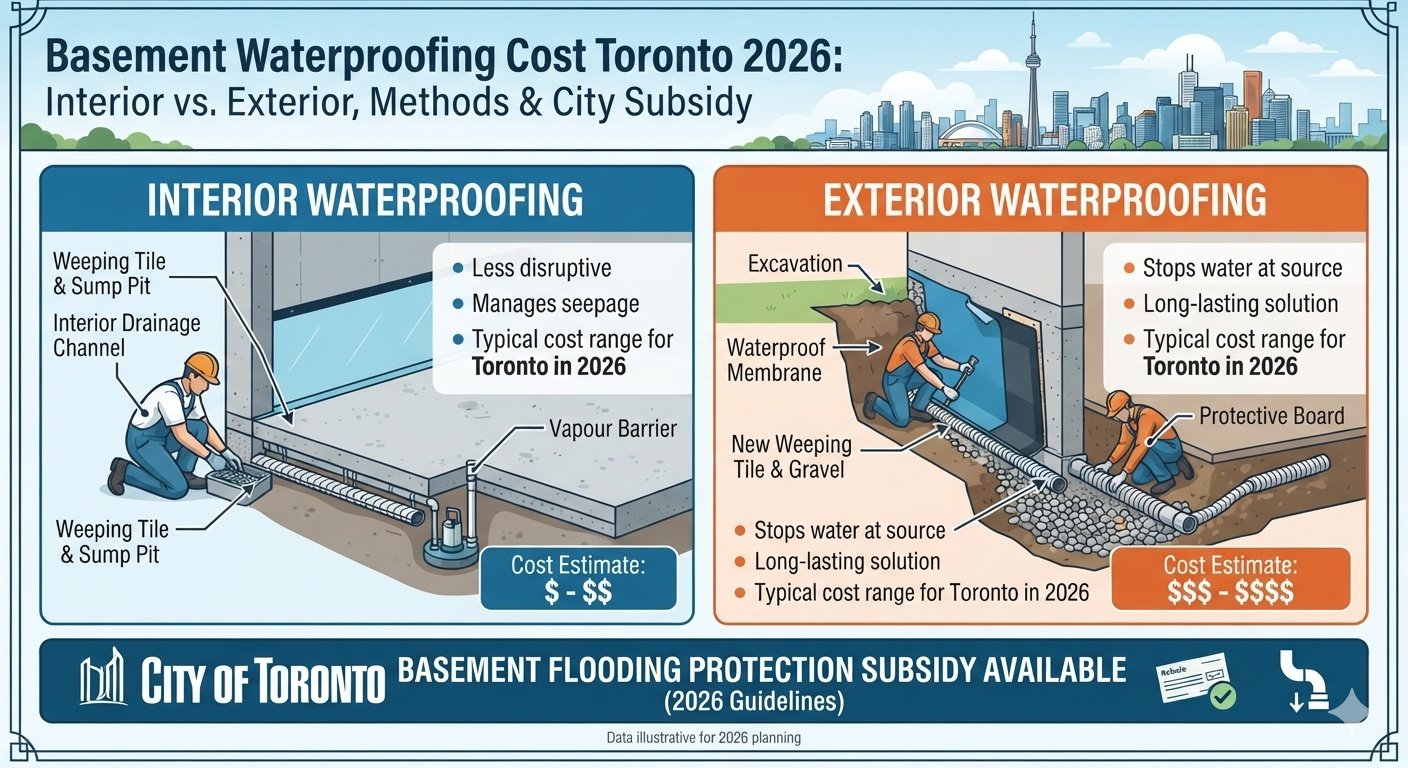
- Interior vs. Exterior Waterproofing: The Core Decision
- Waterproofing Methods & Costs
- Total Project Cost Examples
- City of Toronto Basement Flooding Subsidy — Up to $6,650
- Factors That Affect Your Total Cost
- Signs Your Basement Needs Waterproofing
- Waterproofing Before You Finish Your Basement
- Project Timeline
- How David Reno Can Help
- Frequently Asked Questions
Waterproofing Cost Quick Reference — Toronto 2026
| Method | Cost (Toronto 2026) | What It Addresses | Permanence |
|---|---|---|---|
| Interior drainage system (perimeter) | $80–$120/linear foot ($4,000–$15,000 total) | Manages water after entry; prevents accumulation | Long-term with maintenance |
| Sump pump installation | $1,200–$2,800 installed | Removes water collected by drainage system | 10–15 year pump lifespan |
| Backwater valve | $1,500–$4,000 installed | Prevents sewer backup into basement | Permanent (requires maintenance) |
| Crack injection (epoxy/polyurethane) | $500–$1,500 per crack | Seals isolated poured-concrete cracks | Permanent if crack is stable |
| Exterior waterproofing (full) | $150–$300/linear foot ($15,000–$35,000+ total) | Prevents water reaching foundation wall | Most permanent solution |
| Weeping tile replacement | $100–$200/linear foot | Restores perimeter drainage at footing level | 25–50 year lifespan (new pipe) |
| Waterproof membrane (exterior) | $8–$15/sq ft | Barrier against water penetration at wall | 20–30 year lifespan |
| Window well installation | $800–$2,500 per well | Drainage at below-grade windows; prevents seepage | Long-term with drainage |
Why Toronto Basements Are Especially Vulnerable
Basement water problems are not evenly distributed across housing types and ages. Toronto’s specific combination of housing stock, soil, and infrastructure creates conditions that make basement moisture particularly common here.
Aging Weeping Tile Systems
Toronto homes built before 1980 often sit on older weeping tile systems that may need replacement as part of any waterproofing project, adding to the overall cost. Original clay tile or concrete weeping tile — used in virtually every Toronto home built before 1980 — cracks, collapses, and gets blocked by roots over time. When weeping tile fails, there is nothing to carry groundwater away from the foundation footing. Water accumulates, rises, and finds its way through any crack or gap in the foundation wall.
Clay Soil in the GTA
Toronto’s native soil is heavy clay — it absorbs water slowly and releases it even more slowly. After heavy rain, clay soil holds moisture against the foundation for days or weeks. This prolonged hydrostatic pressure is the primary driver of basement leaks in Toronto’s older housing stock. It’s why a basement can be dry for years and then suddenly start leaking after a particularly wet September.
Overwhelmed Storm Sewer Infrastructure
Toronto’s sewer system was designed for a smaller city with lighter rainfall patterns. Intense storm events — now increasingly common — overwhelm the combined sewer system, causing sewer backup that flows backward into basement floor drains. A backwater valve is the only effective prevention for this type of flooding — and the City of Toronto now subsidizes its installation.
Foundation Age and Type
Toronto has significant housing stock from three distinct eras, each with its own water vulnerability:
- Pre-1940 (stone or brick rubble foundations): Porous by nature — water seeps through the wall itself. These foundations require exterior waterproofing or interior drainage systems, not crack injection.
- 1940s–1970s (poured concrete or concrete block): More structurally sound but prone to cracking as the foundation settles and the original parging (exterior coating) deteriorates. Crack injection works for isolated poured-concrete cracks; block foundations need different approaches.
- Post-1980 (poured concrete): Generally better waterproofed at original construction, but original membrane has aged, and weeping tile systems are approaching end of life.
Interior vs. Exterior Waterproofing: The Core Decision
| Interior Waterproofing | Exterior Waterproofing | |
|---|---|---|
| What it does | Manages water after it enters the foundation — collects and removes it | Stops water before it reaches the foundation wall |
| Cost range (Toronto) | $4,000 – $15,000 | $15,000 – $35,000+ |
| Disruption | Interior work only — basement must be cleared; no yard disturbance | Full exterior excavation — significant yard, driveway, or landscaping disruption |
| Effectiveness | Highly effective at preventing water accumulation and flooding | Most thorough solution — addresses the source directly |
| Stops wall seeping? | No — water still enters wall; drainage system catches it | Yes — membrane prevents water from reaching wall |
| Finish-able after? | Yes — drain channel and sump pit can be framed around | Yes — and walls are fully dry |
| Toronto lot access | No access issues | Tight lots and side passages add significant labour cost |
| City subsidy eligible? | Sump pump: yes. Backwater valve: yes. | Pipe severance: yes. Otherwise limited. |
| Best for | Most Toronto homes — practical, effective, faster | Severe water infiltration, failing exterior membrane, rubble foundations |
Waterproofing Methods & Costs
Interior Drainage System (Perimeter Channel) — $80–$120/linear foot
An interior drainage system is the most common basement waterproofing solution for Toronto homes. A channel is cut around the interior perimeter of the basement floor, a drainage membrane or pipe is installed, and the channel is filled with gravel and recapped with concrete. Water that enters the foundation wall is intercepted at the footing level and directed to a sump pit, where a sump pump removes it from the home.
| Project Size | Linear Feet | Cost Range |
|---|---|---|
| Small Toronto basement (semi-detached) | 80 – 120 lf | $6,400 – $14,400 |
| Standard Toronto basement (detached) | 120 – 160 lf | $9,600 – $19,200 |
| Partial perimeter (problem walls only) | 40 – 60 lf | $3,200 – $7,200 |
What’s included: Concrete cutting, channel excavation, drainage membrane or pipe, gravel, concrete re-pour, sump pit (if new), wall membrane application, and cleanup.
What it does not include: Sump pump itself (quoted separately), finishing work (drywall, flooring), or any exterior work.
Pros: No yard disruption, significantly lower cost than exterior, can be done any season, effective for the vast majority of Toronto moisture problems.
Cons: Does not stop water from entering the wall — only manages it. Requires a functioning sump pump to work (power outage risk if no battery backup). Wall surfaces may still show moisture marks.
Sump Pump Installation — $1,200–$2,800 installed
A sump pump sits in a pit at the lowest point of the basement floor and automatically removes water collected by the drainage system. It’s the mechanical heart of any interior waterproofing system — without it, the drainage channel has nowhere to send water.
| Sump Pump Type | Cost Installed | Notes |
|---|---|---|
| Submersible sump pump (standard) | $1,200 – $1,800 | Most common residential pump |
| Pedestal sump pump | $900 – $1,500 | Motor above pit — easier access but noisier |
| Battery backup sump pump (add-on) | +$400 – $900 | Activates during power outages — critical in storms |
| High-capacity dual pump system | $2,200 – $4,000 | For high water table or large basements |
Battery backup is essential in Toronto. The most common time a basement floods is during a major storm — exactly when the power is most likely to go out. A sump pump without battery backup stops working precisely when you need it most. The City of Toronto’s Basement Flooding Subsidy covers up to $300 of battery backup cost (new in the May 2026 expansion).
Backwater Valve — $1,500–$4,000 installed
A backwater valve (also called a mainline backwater valve or sewage backflow preventer) is installed on the main sewer line where it exits your home. When the City’s sewer system is overwhelmed during heavy rain, sewage can flow backward through your floor drain into your basement. A backwater valve closes automatically when reverse flow is detected, preventing sewage backup entirely.
This is one of the most underinstalled flood prevention measures in Toronto — and one of the most effective. For homes in areas with combined sanitary and storm sewer systems (common in older Toronto neighbourhoods), a backwater valve is the single most impactful flood prevention investment available.
| Backwater Valve Scenario | Cost |
|---|---|
| Accessible floor drain installation (basement floor) | $1,500 – $2,500 |
| Deep mainline installation (concrete cutting required) | $2,500 – $4,000 |
| Two devices (mainline + secondary drain) | $3,000 – $6,500 |
City of Toronto subsidy: 80% of cost, up to $1,600 per device (maximum 2 devices). This is one of the highest-value subsidy items relative to total project cost.
Important note: Backwater valves require annual maintenance — the flap mechanism must be checked and cleaned to function correctly. A valve that hasn’t been maintained can fail open (allowing sewage backup) or fail closed (blocking normal drainage). David Reno provides maintenance guidance at installation.
Crack Injection (Epoxy or Polyurethane) — $500–$1,500 per crack
Crack injection is the right solution for isolated, stable cracks in poured-concrete foundation walls. A contractor drills injection ports along the crack, then injects either epoxy (rigid bond, structural repair) or polyurethane foam (flexible, water-activated) under pressure to fill the crack from interior to exterior.
| Injection Material | Cost per Crack | Best For |
|---|---|---|
| Polyurethane foam injection | $500 – $1,000 | Active water leaks; flexible — accommodates slight movement |
| Epoxy injection | $700 – $1,500 | Structural repair; rigid bond — for stable, dry cracks |
Works for: Poured concrete foundations with isolated vertical or diagonal cracks. Fast, minimally disruptive, permanent when crack is stable.
Does not work for: Block foundations (water enters at mortar joints, not through crack injection points), rubble stone foundations, horizontal cracks (may indicate wall movement — structural assessment required), or foundations with multiple widespread cracks (where drainage system is more appropriate).
Exterior Waterproofing (Excavation & Membrane) — $150–$300/linear foot
Exterior waterproofing is the most complete solution — and the most expensive. The yard or hardscape around the home is excavated to the base of the foundation, the exterior wall is cleaned and inspected, a waterproof membrane is applied to the full foundation wall height, a new drainage layer and weeping tile are installed, and the excavation is backfilled.
Labour makes up the majority of exterior waterproofing costs in Toronto, not materials: excavation, backfill, and site restoration in tight urban lots often drive quotes higher than homeowners expect. A semi-detached home with a shared wall and a 3-foot side passage costs significantly more per linear foot than a detached home with open yard access.
| Exterior Waterproofing Scenario | Cost |
|---|---|
| Single wall (rear only, open access) | $15,000 – $22,000 |
| Two walls (rear + one side) | $22,000 – $35,000 |
| Full perimeter (detached home, open lot) | $30,000 – $55,000+ |
| Full perimeter (semi-detached, tight access) | $35,000 – $65,000+ |
| Driveway/hardscape restoration (if disturbed) | $3,000 – $12,000 additional |
What’s included: Excavation, wall cleaning and preparation, waterproof membrane application, drainage board, new weeping tile, gravel backfill, surface restoration.
What drives costs higher in Toronto: Deep foundations (pre-1960 homes often have 8–10 foot deep foundations), clay soil that is heavy to excavate and dispose of, tight lot access requiring hand-digging, shoring requirements near property lines, and hardscape (brick driveways, interlock patios) that must be restored.
Weeping Tile Replacement — $100–$200/linear foot
Weeping tile (also called foundation drain tile) is the perforated pipe at the base of the foundation footing that collects groundwater and directs it away from the home. Original clay or concrete weeping tile from pre-1980 construction regularly reaches the end of its functional life — blocked by roots, collapsed from soil movement, or simply disintegrated.
Weeping tile replacement is typically done as part of exterior waterproofing — the excavation required is the same. New perforated plastic pipe wrapped in filter fabric replaces the original system and provides 25–50 years of drainage life.
Interior weeping tile alternative: An interior drain channel system (described above) functionally replaces weeping tile from the inside — at a fraction of the cost of exterior excavation. For most Toronto homeowners with failed weeping tile, an interior system is the practical solution.
Window Well Installation — $800–$2,500 per well
Below-grade windows without proper drainage allow water to collect against the window frame, seep through the sill, and enter the basement. A properly installed window well with a gravel drainage base and, in larger wells, a perforated drain pipe connecting to the weeping tile system, prevents this accumulation.
Window well installation is also a component of egress window projects — required in any basement bedroom. See our Basement Renovation Cost Guide for egress window costs and requirements.
Total Project Cost Examples
Scenario 1 — Sewer Backup Prevention: Backwater Valve + Battery Backup Sump Pump
Best for: Homes in older Toronto neighbourhoods with combined sewer systems — Roncesvalles, Leslieville, East York, Parkdale, Annex.
- Backwater valve installation (mainline): $2,000 – $3,500
- Battery backup sump pump: $1,600 – $2,700
- Total project cost: $3,600 – $6,200
- City of Toronto subsidy (backwater valve $1,600 + sump pump $1,750 + battery $300): up to $3,650
- Net cost after subsidy: $0 – $2,550
This is the highest-ROI waterproofing project in Toronto — the subsidy covers most or all of the cost, and the protection against sewer backup is immediate.
Scenario 2 — Interior Waterproofing: Partial Perimeter + Sump Pump
Best for: Homes with seeping on one or two walls — wet corner, water mark along one wall, damp floor near foundation edge.
- Interior drainage channel (50 lf, two walls): $4,000 – $6,000
- Wall membrane on affected walls: $800 – $1,500
- New sump pump + pit: $1,500 – $2,200
- Battery backup: $500 – $900
- Total project cost: $6,800 – $10,600
- City subsidy (sump pump $1,750 + battery $300): up to $2,050
- Net cost after subsidy: $4,750 – $8,550
Scenario 3 — Full Interior Waterproofing System
Best for: Homes with pervasive moisture throughout the basement — multiple wet walls, water on the floor after heavy rain, visible efflorescence throughout.
- Full perimeter interior drainage (140 lf): $11,200 – $16,800
- Wall membrane (full perimeter): $2,000 – $4,000
- Sump pump system with battery backup: $2,000 – $3,600
- Backwater valve (if sewer backup risk): $2,000 – $3,500
- Crack injection (2 cracks): $1,000 – $3,000
- Total project cost: $18,200 – $30,900
- City subsidy (backwater + sump + battery + assessment): up to $4,350
- Net cost after subsidy: $13,850 – $26,550
Scenario 4 — Exterior Waterproofing (Rear Wall, Open Access)
Best for: Homes where exterior membrane has failed, foundation damage is visible, or interior system alone is insufficient.
- Exterior excavation + membrane + drainage board (rear wall, 40 lf): $16,000 – $24,000
- New weeping tile (rear): $4,000 – $8,000
- Backfill + surface restoration: $3,000 – $6,000
- Interior sump pump (if not existing): $1,500 – $2,200
- Total project cost: $24,500 – $40,200
- City subsidy (pipe severance if applicable $2,800 + sump $1,750): up to $4,550
City of Toronto Basement Flooding Subsidy — Up to $6,650
City of Toronto Basement Flooding Protection Subsidy ✅ ACTIVE — Expanded May 2026
Up to $6,650 per property
The City of Toronto expanded this program in May 2026 — increasing the maximum subsidy from $3,400 to $6,650 and adding new eligible items. This is the most directly applicable government program for Toronto homeowners doing waterproofing work.
| Eligible Work | Subsidy | New in 2026? |
|---|---|---|
| Home plumbing assessment (licensed plumber) | 80% of cost, up to $500 | No |
| Backwater valve installation | 80% of cost, up to $1,600 per device (max 2) | No (amount increased) |
| Sump pump installation | 80% of cost, up to $1,750 per pump | No (amount increased) |
| Sump pump alarm (high-water) | Up to $200 | No |
| Sump pump battery backup | Up to $300 | Yes — NEW in 2026 |
| Pipe severance (disconnect storm sewer) | 80% of cost, up to $2,800 | No (amount increased) |
Key requirements:
- Property must be within City of Toronto boundaries (not Mississauga, Markham, Vaughan, etc.)
- Eligible property types: single-family, duplex, triplex, fourplex residential
- Work must be performed by a contractor with a valid City of Toronto business licence
- Permits required where specified — David Reno manages all permit applications
- Apply after eligible work is completed and inspected
- Properties have a lifetime maximum per eligible item — check your address history at the City before starting
- Subsidies subject to funding availability
How to apply: Online at toronto.ca — search “Basement Flooding Protection Subsidy.” You will need contractor invoices, before/after photos where applicable, and documentation of completed work.
Factors That Affect Your Total Cost
1. Foundation Type
Poured concrete foundations are the most straightforward to waterproof — crack injection works for isolated cracks, and interior drainage installs cleanly along the footing. Concrete block foundations are more complex — water enters at mortar joints throughout the wall, not at a single crack point. Rubble stone foundations (common in Toronto homes built before 1920) are inherently porous and typically require exterior waterproofing or heavy interior drainage — no surface sealing product is effective long-term on stone.
2. Foundation Depth
Deeper foundations cost more to excavate and work in. Toronto’s older homes — particularly in the Annex, Rosedale, and Forest Hill — frequently have 8–10 foot foundation depths. Every additional foot of excavation depth increases labour time and soil disposal costs.
3. Lot Access
Labour makes up the majority of exterior waterproofing costs in Toronto, not materials: excavation, backfill, and site restoration in tight urban lots often drive quotes higher than homeowners expect. A semi-detached home with a 2-foot side passage may require hand-digging, smaller equipment, or even crane access for soil removal — easily adding $5,000–$10,000 to an exterior project.
4. Existing Sump Pit
If your basement already has a sump pit, a pump replacement or upgrade costs $800–$1,400. If no pit exists, creating one (concrete cutting + pit liner + connection to drainage system) adds $800–$1,500 to the project.
5. Hardscape Restoration
Exterior waterproofing that disturbs a concrete driveway, interlock stone patio, or landscaped garden requires restoration after backfill. Interlock restoration: $3,000–$8,000. Concrete driveway section: $2,000–$5,000. Landscaping restoration: variable. Always confirm how surface restoration is priced in any exterior waterproofing quote — it’s a significant and often underquoted cost component.
6. Presence of Hazardous Materials
Older Toronto homes may have asbestos-containing materials in the basement — floor tiles, pipe insulation, or wall materials. Any asbestos identified during waterproofing work must be addressed by a licensed abatement contractor before the waterproofing proceeds. Testing and abatement: $1,500–$5,000 depending on scope.
Signs Your Basement Needs Waterproofing
These are the warning signs Toronto homeowners most commonly describe when they call David Reno about basement moisture:
- White chalky deposits on foundation walls (efflorescence): Mineral salts left behind as water moves through the wall and evaporates. Confirms water is actively moving through the concrete.
- Water on the floor after heavy rain: Particularly if it appears near the wall-floor junction — the most common entry point for hydrostatic water in Toronto basements.
- Musty smell in the basement: The smell of mould — which begins growing within 24–48 hours of moisture contact with organic material (wood, drywall paper).
- Staining or rust marks on concrete walls: Indicate water seepage pathways.
- Cracks in the foundation wall: Vertical and diagonal cracks in poured concrete are common and can often be injected. Horizontal cracks require structural assessment.
- Peeling paint or bubbling on basement walls: Moisture migrating through the concrete lifts paint from the surface.
- Your sump pump runs frequently: If it cycles more than every 15 minutes during heavy rain, your drainage system is managing significant water volume — worth having the system assessed.
- Your home is pre-1980 and has never had waterproofing work done: The original weeping tile and exterior membrane (if any) are near or past end of life.
Waterproofing Before You Finish Your Basement
If you’re planning to finish your basement — adding drywall, flooring, a bathroom, or a bedroom — waterproofing must happen first. This is the most common and most expensive sequence mistake Toronto homeowners make.
Finishing a basement before waterproofing it is a one-way door. Once drywall is installed and flooring is laid, any subsequent water intrusion damages the finished space immediately. Re-waterproofing a finished basement means tearing out the finishing, doing the waterproofing, and rebuilding — paying for the finishing work twice.
The correct sequence is always: waterproof → insulate → frame → mechanical → drywall → finish. David Reno follows this sequence on every basement renovation project and will never begin finishing work in a basement with unresolved moisture issues.
See our Basement Renovation Cost Guide for full details on finishing costs and sequence.
Project Timeline
| Method | Duration | Notes |
|---|---|---|
| Crack injection (1–2 cracks) | Half day – 1 day | Cure time: epoxy 24–48 hrs, polyurethane 2–4 hrs |
| Backwater valve installation | 1 day | Concrete cutting, plumbing, re-pour |
| Sump pump installation (new pit) | 1 day | Concrete cutting, pit liner, plumbing, pump |
| Interior drainage system (partial) | 2–3 days | Cutting, installation, concrete re-pour (cure 24 hrs) |
| Interior drainage system (full perimeter) | 3–5 days | Cutting, installation, concrete re-pour throughout |
| Exterior waterproofing (single wall) | 5–8 days | Excavation, membrane, drainage, backfill, restoration |
| Exterior waterproofing (full perimeter) | 10–20 days | Includes hardscape restoration time |
The home is liveable throughout most waterproofing projects. Interior drainage work creates dust and some disruption; the basement must be cleared but the rest of the home is unaffected. Exterior projects require temporary loss of yard or driveway access for the duration.
How David Reno Can Help
Basement waterproofing is one of the most technically varied renovation categories — the right solution depends on your specific foundation type, moisture source, lot configuration, and budget. David Reno brings the same structured approach we apply to every project: assess the actual problem first, recommend the solution that addresses it, and provide a written fixed-price quote before any work begins.
What David Reno handles:
- Free basement moisture assessment: We inspect your foundation walls, floor, and drainage, identify moisture sources, and determine the most appropriate waterproofing method for your specific situation
- City of Toronto subsidy review: We confirm which work qualifies for the Basement Flooding Protection Subsidy and provide all documentation required for your application
- City of Toronto business licence: David Reno holds a valid City of Toronto business licence — required for subsidy-eligible work
- Interior drainage system: Full perimeter or partial — concrete cutting, drainage channel, wall membrane, sump pit, and concrete restoration
- Sump pump installation: Supply and installation of submersible pump, discharge line, battery backup, and high-water alarm
- Backwater valve installation: Licensed plumber coordination and permit management for mainline installation
- Crack injection: Polyurethane or epoxy as appropriate for your specific crack type and condition
- Exterior waterproofing coordination: For projects requiring excavation, we manage the full scope including excavation, membrane application, weeping tile, and surface restoration
- Permit management: All required permits (plumbing, building where applicable)
- Waterproofing as prerequisite to basement finishing: Every basement renovation David Reno completes begins with a moisture assessment and waterproofing if needed — before any framing or finishing work begins
- Written warranty: All David Reno waterproofing work is warranted in writing
Frequently Asked Questions
How much does basement waterproofing cost in Toronto in 2026?
Basement waterproofing in Toronto costs between $80 and $300 per linear foot in 2026, depending on the method, foundation depth, and site conditions. Most homeowners spend between $8,000 and $20,000 for a full interior or exterior system. Specific costs: backwater valve installation runs $1,500–$4,000; sump pump $1,200–$2,800; crack injection $500–$1,500 per crack; full interior perimeter drainage system $9,600–$19,200 for a standard Toronto home; full exterior waterproofing $24,000–$65,000+ depending on access and scope. The City of Toronto Basement Flooding Subsidy covers up to $6,650 of eligible work.
What is the difference between interior and exterior basement waterproofing?
Interior waterproofing installs a drainage system inside the basement — it intercepts water that enters the foundation and removes it via sump pump. It does not stop water from entering the wall, but it prevents flooding and moisture accumulation. Cost: $4,000–$15,000. Exterior waterproofing excavates around the foundation and applies a waterproof membrane to the outside of the wall — stopping water before it reaches the foundation. It’s the most thorough solution but costs 2–4 times more. For most Toronto homeowners with typical moisture problems, interior waterproofing delivers effective, long-term results at a fraction of exterior cost.
What does the City of Toronto Basement Flooding Subsidy cover in 2026?
The City of Toronto Basement Flooding Protection Subsidy (expanded May 2026) covers 80% of eligible costs to the following maximums: home plumbing assessment ($500), backwater valve ($1,600 per device, max 2), sump pump ($1,750), high-water alarm ($200), sump pump battery backup ($300, new in 2026), and pipe severance ($2,800). Maximum total subsidy: $6,650. Work must be done by a contractor with a valid City of Toronto business licence. Apply at toronto.ca after work is completed and inspected.
Does my Toronto home need a backwater valve?
If your home is in an older Toronto neighbourhood with a combined sanitary and storm sewer system — which includes most homes built before 1975 in areas like Roncesvalles, East York, Parkdale, the Annex, Leslieville, and many others — a backwater valve is strongly recommended. Sewer backup during heavy storms is a growing problem as Toronto’s rainfall intensity increases. A backwater valve is the only device that physically prevents sewage from flowing backward into your basement through the floor drain. The City of Toronto subsidizes 80% of the cost up to $1,600 per device.
Should I waterproof my basement before finishing it?
Always. Finishing a basement with unresolved moisture problems guarantees future damage to drywall, insulation, flooring, and anything stored in the space. Remediating water damage in a finished basement means tearing out the finishing and paying for it twice. The correct order is: waterproof first, then insulate, frame, and finish. David Reno will not begin basement finishing work in a space with active or likely moisture issues — we address waterproofing first.
Is fall a good time to waterproof a basement in Toronto?
Yes — fall is actually one of the best times for basement waterproofing in Toronto. The fall rain season makes the moisture problem visible and confirms exactly where water is entering, making diagnosis straightforward. Interior drainage work can be done any season. For exterior work, September and October offer good working conditions before ground freeze. Addressing moisture in fall means your basement is protected through the entire winter season. And if you’re planning a spring basement renovation, waterproofing now means the space is dry and ready for finishing in the new year.
Wet Basement? Let’s Fix It Before Winter — and Before You Finish It
Toronto’s fall rain season is the best time to diagnose a basement moisture problem — it shows you exactly where water is coming in and confirms whether you need a backwater valve, interior drainage system, crack injection, or exterior waterproofing. Getting the right solution matters as much as getting it done.
David Reno assesses, plans, and executes basement waterproofing across Toronto and the GTA — and we coordinate the City of Toronto Basement Flooding Subsidy application so you capture every eligible dollar. No wet basement should go into a Toronto winter unaddressed.
We serve North York, Scarborough, Etobicoke, Leaside, Roncesvalles, The Annex, East York, The Beach, Mississauga, Markham, Richmond Hill, and all of Toronto and the GTA.
💧 Call us today: (647) 463-2246
📧 Email: info@davidreno.ca
📍 Serving all of Toronto & GTA
⚡ Fall is the right season — book your free basement assessment before October’s heavy rains.