
October arrives in Toronto, and the furnace comes back to life for the first time since April. For some homeowners, it starts without a thought. For others, it’s the moment they discover a problem they’ve been putting off — the furnace that cycles oddly, the heat that never quite distributes right, the energy bill that’s been creeping upward for three years.
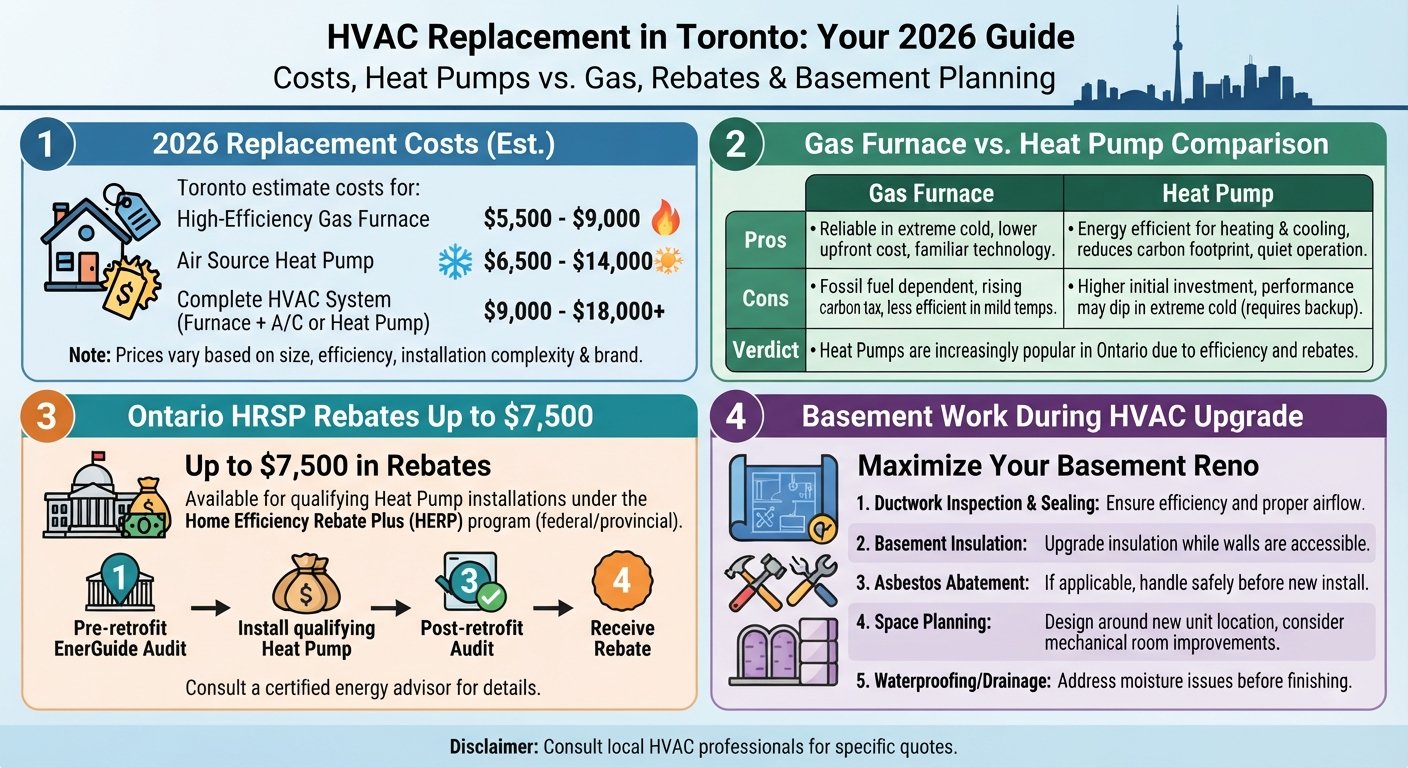
If yours is older than 15 years, breaks down regularly, or has a cracked heat exchanger, replacement is usually the more cost-effective choice — and fall is the right time to make that call before a mid-winter failure forces an emergency replacement at premium pricing. The decision is more complex than it used to be. In 2026, Toronto homeowners replacing their heating system face a genuine choice between gas furnace, cold-climate heat pump, and hybrid systems — with Ontario rebates of up to $7,500 now making heat pumps financially competitive in a way they weren’t just three years ago.
But here’s what most HVAC guides don’t tell you: the smartest time to address your basement is the same moment your HVAC system is being replaced. When your furnace technician is already in the mechanical room, ducts are accessible, and the basement is disrupted anyway — it’s the optimal window for insulation upgrades, ductwork improvements, moisture work, and basement finishing preparation. Two projects coordinated properly cost less than two projects done sequentially.
At David Reno, we handle the renovation side of this equation — the basement work, insulation, structural improvements, and finishing that turn an HVAC replacement project into a complete basement upgrade. This guide gives you real 2026 Toronto HVAC pricing, an honest gas vs. heat pump comparison, the rebates you can actually claim, and exactly which basement projects to tackle at the same time.
Table of Contents
- HVAC Cost Quick Reference — Toronto 2026
- Replace or Repair? The 15-Year Rule
- Gas Furnace Replacement Cost
- Cold-Climate Heat Pump Cost
- Hybrid System (Heat Pump + Gas Furnace)
- Central Air Conditioning
- Gas Furnace vs Heat Pump: The Honest Toronto Comparison
- Ontario Rebates for HVAC in 2026
- The Basement Connection: What to Do at the Same Time
- Combined Project Cost Examples
- Permits Required in Toronto
- Fall Timing — Why October Matters
- How David Reno Fits In
- Frequently Asked Questions
HVAC Cost Quick Reference — Toronto 2026
| System | Installed Cost (Toronto) | HRSP Rebate | Net Cost (After Rebate) | Heating + Cooling? |
|---|---|---|---|---|
| Gas furnace (95%+ AFUE) | $4,900 – $7,500 | None | $4,900 – $7,500 | Heating only |
| Gas furnace + central AC | $8,500 – $14,000 | None | $8,500 – $14,000 | ✅ Both |
| Cold-climate heat pump (ducted) | $9,000 – $16,000 | Up to $7,500 | $1,500 – $8,500 | ✅ Both |
| Hybrid system (heat pump + gas backup) | $6,500 – $12,000 (heat pump component) | Up to $7,500 | $0 – $4,500 | ✅ Both |
| Ductless mini-split (1 zone) | $5,000 – $8,500 | Up to $7,500 | $0 – $1,000 | ✅ Both (1 zone) |
| Ductless mini-split (whole home, 3–4 zones) | $14,000 – $22,000 | Up to $7,500 | $6,500 – $14,500 | ✅ Both |
Replace or Repair? The 15-Year Rule
The decision between repair and replacement follows a consistent rule that HVAC technicians apply across the industry:
| Furnace Age | Repair Cost Threshold | Recommendation |
|---|---|---|
| Under 10 years | Any repair under $1,500 | Repair — still early in service life |
| 10–15 years | Repair under $1,000 | Repair for minor issues; plan for replacement |
| 15–20 years | Repair over $800–$1,200 | Replace — approaching end of service life |
| Over 20 years | Any significant repair | Replace — efficiency losses alone justify it |
Non-negotiable replacement scenarios:
- Cracked heat exchanger: A cracked heat exchanger allows combustion gases (including carbon monoxide) to mix with circulated air. This is a safety issue — the furnace must be replaced, not repaired.
- Repeated breakdowns in one season: Two or more service calls in a single heating season signal systemic failure.
- No parts available: Many manufacturers stop producing parts for furnaces over 20 years old.
- 80% AFUE or lower efficiency: Modern 95%+ AFUE furnaces use 15–19% less gas — the annual savings often justify replacement even when the old furnace still runs.
Gas Furnace Replacement Cost
Natural Gas Furnace — $4,900 to $9,000+ Installed
Natural gas remains the most common heating fuel in Toronto homes with existing ductwork, offering the lowest installed cost and the most straightforward replacement process. (cite index=”1-1″>A typical high-efficiency gas furnace replacement in Toronto runs $4,900–$7,500 installed, including the unit, labour, venting, and permits.
| Gas Furnace Type | AFUE Efficiency | Installed Cost (Toronto) | Best For |
|---|---|---|---|
| Single-stage (basic) | 80% – 92% | $3,800 – $5,500 | Budget replacement, rental properties |
| Two-stage (standard upgrade) | 95% – 96% | $4,900 – $7,000 | Most Toronto homes — best value |
| Modulating (variable output) | 96% – 98%+ | $6,500 – $9,000+ | Larger homes, maximum comfort and efficiency |
What a Toronto furnace replacement typically includes:
- New furnace unit (sized by HVAC tech using heat loss calculation)
- Removal and disposal of old furnace
- New PVC venting for condensing (95%+) units
- Gas line connection
- Electrical connection and control wiring
- Condensate drain (for high-efficiency units)
- TSSA gas permit and inspection
- Start-up, commissioning, and testing
What adds cost in Toronto specifically:
- New venting when switching from 80% to 95%+ (different flue material)
- Gas line upgrade if moving furnace location
- Electrical panel upgrade if existing panel lacks capacity
- Tight mechanical room access (common in older Toronto homes)
- Asbestos on existing ductwork or insulation (requires abatement)
Cold-Climate Heat Pump Cost
Cold-Climate Air-Source Heat Pump — $9,000 to $16,000 Installed (Before Rebates)
A cold-climate air-source heat pump is an electrically driven system that moves heat from outdoor air into your home in winter, and reverses direction to cool in summer. Modern cold-climate models are rated to operate effectively down to -25°C — the temperature threshold that makes them viable as a primary heating source for Toronto’s climate.
(cite index=”5-1″>In Ontario, the Home Renovation Savings Program provides rebates of up to roughly $7,500 for cold-climate air-source heat pumps. This rebate fundamentally changes the cost calculation — a $12,000 heat pump becomes a $4,500 net cost after rebate, competitive with a mid-range gas furnace that qualifies for no rebate at all.
| Heat Pump Type | Installed Cost (Toronto) | HRSP Rebate | Net Cost |
|---|---|---|---|
| Ducted air-source (replaces furnace + AC) | $9,000 – $14,000 | Up to $7,500 | $1,500 – $6,500 |
| Cold-climate ducted (rated -25°C) | $11,000 – $16,000 | Up to $7,500 | $3,500 – $8,500 |
| Ductless mini-split (1 zone) | $5,000 – $8,500 | Up to $7,500 | $0 – $1,000 |
| Multi-zone ductless (3–4 zones) | $14,000 – $22,000 | Up to $7,500 | $6,500 – $14,500 |
Hybrid System (Heat Pump + Gas Furnace)
Hybrid System — $6,500 to $12,000 (Heat Pump Component)
(cite index=”5-1″>A hybrid system pairs an electric heat pump that handles the bulk of the heating season at high efficiency, with a gas furnace that kicks in when outdoor temperatures drop to the point where gas becomes cheaper or when the heat pump reaches its design limits. This is the most practical entry point for homeowners whose gas furnace still has service life remaining.
How it works: The heat pump operates as the primary heating source down to approximately -15°C to -20°C, where it handles heating most efficiently. When temperatures drop further or during peak demand, the gas furnace provides backup heat. The system switches automatically based on outdoor temperature and efficiency thresholds.
Best for Toronto homeowners who:
- Have a gas furnace with 3–8 years of service life remaining
- Want to capture heat pump efficiency and the HRSP rebate now
- Are not ready for a full system replacement
- Have central AC that is also due for replacement (heat pump replaces AC)
Cost strategy: Adding a heat pump to an existing functioning furnace costs $6,500–$12,000 for the heat pump component, qualifies for up to $7,500 HRSP rebate, and effectively gives you a complete heating and cooling system upgrade for $0–$4,500 net — while keeping the furnace as backup.
Central Air Conditioning
Central AC Replacement — $3,500 to $7,500 Installed
If you’re replacing your furnace and your central AC unit is over 12 years old, replacing both at the same time costs less than replacing them separately — shared labour and a single HVAC mobilization.
| AC Type | Efficiency (SEER2) | Installed Cost |
|---|---|---|
| Standard central AC | 14 – 16 SEER2 | $3,500 – $5,500 |
| High-efficiency central AC | 18 – 21 SEER2 | $5,000 – $7,500 |
| Cold-climate heat pump (replaces both) | Dual function | $9,000 – $16,000 (before rebates) |
The math when both are due: Gas furnace + AC = $8,500–$14,000, no rebate. Heat pump (replaces both) = $9,000–$16,000, minus $7,500 HRSP rebate = $1,500–$8,500 net. The heat pump is frequently the better total cost when both systems need replacement simultaneously.
Gas Furnace vs Heat Pump: The Honest Toronto Comparison
| Gas Furnace (95%+) | Cold-Climate Heat Pump | Hybrid System | |
|---|---|---|---|
| Installed cost (Toronto) | $4,900 – $7,500 | $9,000 – $16,000 | $6,500 – $12,000 (HP component) |
| HRSP rebate available | None | Up to $7,500 | Up to $7,500 |
| Net cost after rebate | $4,900 – $7,500 | $1,500 – $8,500 | $0 – $4,500 |
| Annual heating cost (typical Toronto home) | $1,200 – $1,800 | $700 – $1,300 | $900 – $1,400 |
| Provides cooling? | No (separate AC needed) | Yes — replaces AC | Yes — replaces AC |
| Carbon emissions | 3.3 tonnes CO₂/year (avg. Toronto home) | Near-zero with grid electricity | Significantly reduced |
| Works in -25°C? | Yes | Yes (cold-climate models) | Yes (gas backup for extreme cold) |
| Installation complexity | Low — same as existing | Moderate — outdoor unit, electrical | Moderate — adds outdoor unit |
| Electrical panel upgrade needed? | Rarely | Often (240V circuit required) | Often (240V circuit required) |
| 10-year total cost of ownership | $16,000 – $25,000 | $8,500 – $20,000 | $10,000 – $20,000 |
The verdict for Toronto in 2026: (cite index=”5-1″>The Canadian Climate Institute calculated that replacing a gas furnace and air conditioner with an air-source heat pump would typically save money in Toronto over the lifetime of the equipment. With the HRSP rebate making the upfront gap much smaller, and with the heat pump replacing both furnace and AC, a cold-climate heat pump is the financially sound choice for most Toronto homeowners replacing both systems simultaneously. For homeowners whose furnace still has service life, a hybrid system captures the rebate and efficiency benefits now at lower disruption.
Ontario Rebates for HVAC in 2026
Ontario Home Renovation Savings Program (HRSP) — Heat Pump Rebate ✅ ACTIVE
Up to $7,500 for cold-climate air-source heat pump
This is the primary active rebate for heat pump installation in Ontario in 2026. (cite index=”5-1″>In Ontario, the Home Renovation Savings Program provides rebates of up to roughly $7,500 for cold-climate air-source heat pumps.
- Qualifying equipment: Cold-climate certified air-source heat pump (ducted or ductless)
- Pre-assessment required: EnerGuide home energy assessment before installation (for bundled pathway)
- Can be combined with: Attic insulation rebate (up to $7,700), window rebate ($100/window), and Enbridge HER
- How to apply: homerenovationsavings.ca
Enbridge Gas Home Efficiency Rebate (HER) ✅ ACTIVE
Up to $5,000 (combined upgrades, Enbridge customers only)
(cite index=”8-1″>Ontario’s Enbridge Gas rebate of $2,000–$5,000 is available to Enbridge Gas customers switching from natural gas heating or adding qualifying heat pump equipment. Requires a pre-retrofit EnerGuide assessment and minimum two qualifying upgrades.
Oil to Heat Pump Affordability Program ✅ ACTIVE
Up to $10,000 federal grant
For the smaller proportion of Toronto homes still heating with oil — particularly older detached homes in Etobicoke and Scarborough — this federal program offers up to $10,000 toward a qualifying cold-climate heat pump replacement. Stackable with the HRSP. See our Toronto Renovation Rebates Guide for details.
The Basement Connection: What to Do at the Same Time
Here’s the insight most HVAC contractors won’t mention: your furnace replacement is the best window you’ll have to tackle a range of basement improvements — because the mechanical room is already disrupted, trades are already mobilized, and decisions about your home’s envelope and systems are already being made. Doing these projects together consistently costs 15–25% less than doing them sequentially, and the sequence matters: mechanical systems before insulation before framing before finishing.
David Reno coordinates the renovation side of HVAC replacement projects — the structural, insulation, waterproofing, and finishing work that surrounds and enables the mechanical upgrade. Here’s exactly what to consider:
1. Basement & Attic Insulation — Do It Before the New System Runs
A new high-efficiency furnace or heat pump running in a poorly insulated home loses much of its efficiency advantage to the building envelope. The biggest heating gains come from improving both the mechanical system and the thermal envelope at the same time.
Basement insulation work to coordinate with HVAC replacement:
- Rim joist insulation: The rim joist — where the floor structure meets the foundation wall — is one of the highest heat-loss points in a Toronto home. Spray foam insulation at the rim joist costs $800–$2,000 and delivers immediate comfort and energy improvement. Done during furnace replacement when the basement is already clear.
- Basement wall insulation: If you’re planning to finish the basement, rigid foam board or batt insulation on foundation walls is installed after waterproofing and before framing. Cost: $1,500–$4,000 depending on scope.
- Attic insulation (coordinate with HRSP): If you’re claiming the HRSP rebate for a heat pump, adding attic insulation to the same rebate application (bundled pathway) captures up to $7,700 additional rebate on top of the $7,500 heat pump rebate — for a combined maximum of $15,200 in rebates on one EnerGuide assessment. See our Attic Insulation Cost Guide.
2. Ductwork Improvements — While It’s All Exposed
Most ductwork in Toronto homes built before 2000 has never been properly sealed or insulated. (cite index=”2-1″>Leaky ducts in unconditioned basements lose 20–30% of conditioned air before it reaches living spaces. A new high-efficiency furnace or heat pump delivering air through leaky ducts loses a significant portion of its efficiency advantage.
Ductwork improvements to consider during HVAC replacement:
- Duct sealing (mastic or foil tape): All accessible duct joints sealed. Cost: $500–$1,500. Improves system efficiency by 10–20%.
- Duct insulation (in unconditioned spaces): Ducts running through uninsulated crawl spaces or cold areas wrapped with insulation. Cost: $1,000–$3,000.
- Duct reconfiguration: If basement is being finished, duct routing may need to change to accommodate ceiling height. Best done before framing — not after drywall is installed. Cost: $1,500–$4,000 depending on scope.
- Return air upgrades: Older Toronto homes often have inadequate return air capacity, which limits furnace and heat pump performance. Adding return air drops during the replacement project improves system airflow. Cost: $500–$2,000.
3. Moisture & Waterproofing — Address It Before You Enclose Anything
Basement moisture and a new HVAC system are an important interaction. A high-efficiency condensing furnace produces significant condensate water — up to 2–3 litres per hour — that must drain effectively. A heat pump adds a condensate drain requirement as well. Existing moisture problems in the basement need to be resolved before any of this equipment is installed, or before walls are framed.
Moisture work to address during HVAC replacement:
- Condensate drain upgrade: Ensure your floor drain and condensate drainage are sized and routed correctly for the new system. Cost: $200–$600 (plumber coordination).
- Sump pump check or upgrade: If a basement sump exists, verify it’s functioning and sized for current conditions. If not, this is the right time. Cost: $1,200–$2,800 installed. City of Toronto subsidy up to $1,750.
- Backwater valve (if not installed): Sewer backup protection — required for City of Toronto subsidy. Cost: $1,500–$4,000. Subsidy up to $1,600.
- Crack injection / waterproofing: Any seeping walls addressed before insulation and framing. Water behind a finished basement wall causes mould — and the repair is expensive. See our Basement Waterproofing Guide.
4. Electrical Panel Upgrade — Often Required for Heat Pumps
Cold-climate heat pumps require a dedicated 240V circuit — and many older Toronto homes don’t have panel capacity for it. If your home has a 100-amp panel (very common in Toronto homes built before 1985), a heat pump installation almost always requires a panel upgrade.
| Panel Situation | Cost | Notes |
|---|---|---|
| 200A panel already installed, capacity available | $0 | Heat pump circuit can be added directly |
| 200A panel upgrade (100A → 200A) | $2,500 – $5,000 | ESA permit required; licensed electrician |
| Add dedicated 240V circuit only | $400 – $800 | If panel already has capacity |
If you’re planning a basement renovation that includes a home office, workshop, or in-law suite, the panel upgrade for the heat pump is also the panel upgrade for the new basement circuits — do it once, not twice.
5. HRV / Fresh Air System — The Missing Piece in Toronto Renovations
When a Toronto home is well-insulated and well-sealed — attic at R-60, new high-efficiency windows, new exterior doors — it becomes very airtight. (cite index=”7-1″>Modern cold-climate heat pumps are designed to operate efficiently at temperatures as low as -25°C, but airtight homes need mechanical fresh air ventilation — the HRV is what makes a sealed home liveable.
A Heat Recovery Ventilator (HRV) brings fresh air into the home while recovering 70–80% of the heat from outgoing stale air. It’s increasingly required by Ontario Building Code for new construction and renovation work that brings the envelope to current standards.
- HRV installation cost: $2,000 – $4,500 installed, connected to existing ductwork
- HRSP rebate for HRV: May qualify as part of the bundled pathway — confirm with your Registered Energy Advisor
- Best time to install: During HVAC replacement, when ductwork connections are already being made
6. Basement Finishing Preparation — Set Up Now, Finish Later
If finishing your basement is a 2027 or 2028 project, the HVAC replacement window is the ideal time to rough-in the work that’s much harder to do later:
- Rough plumbing for basement bathroom: Sub-slab plumbing is done before concrete is poured or restored. Adding this rough-in during a basement project costs $2,500–$5,000 — doing it separately later means cutting concrete again. See our Basement Renovation Guide.
- Sub-floor system: A DeltaFL or Dricore sub-floor over the concrete slab raises the finished floor off the concrete, improving moisture management and comfort. Best installed before stud walls are built. Cost: $2–$5 per sq ft.
- In-floor radiant heat rough-in: If you plan heated floors in a future bathroom or main room, rough-in the tubing before the slab. Far cheaper than cutting concrete later.
- Sound insulation in ceiling: Mineral wool or acoustic batts between basement ceiling joists dramatically reduce sound between floors. Install before drywall — impossible after. Cost: $1,500–$3,500.
- Egress window: Required for any basement sleeping area. Best done when the basement is already under construction. Cost: $2,000–$4,500 with well and structural work.
Combined Project Cost Examples
Scenario A — Gas Furnace Replacement + Rim Joist Insulation + Duct Sealing
For: Homeowner with a 17-year-old furnace, no immediate basement plans, wants efficiency improvement this fall.
- High-efficiency gas furnace (two-stage, 96% AFUE): $5,500 – $7,000
- Rim joist spray foam insulation: $1,000 – $1,800
- Duct sealing (mastic, all accessible joints): $600 – $1,200
- Total: $7,100 – $10,000
- HRSP attic insulation rebate (if added): up to additional $7,700
- Estimated annual gas savings: $300 – $600
Scenario B — Cold-Climate Heat Pump + Attic Insulation + Electrical Panel (Maximum Rebate)
For: Homeowner replacing both furnace (20 years old) and AC (14 years old), wants maximum rebates.
- Cold-climate ducted heat pump (replaces furnace + AC): $11,000 – $14,000
- Electrical panel upgrade (100A → 200A): $3,000 – $4,500
- Attic insulation upgrade to R-60 (1,200 sq ft): $2,500 – $4,500
- Rim joist spray foam: $1,000 – $1,800
- Total before rebates: $17,500 – $24,800
- HRSP heat pump rebate: –$7,500
- HRSP attic insulation rebate: –$7,700
- Enbridge HER (if Enbridge customer): –$2,000 – $3,000
- Net cost after rebates: $0 – $9,600 depending on rebate tier
- Annual energy savings vs. old system: $600 – $1,100
Scenario C — Hybrid System + Basement Renovation Prep + Waterproofing
For: Homeowner whose gas furnace has 5 years left, planning basement finishing in spring 2027, wet basement corner.
- Heat pump addition (hybrid system, AC replacement): $7,500 – $10,500
- Interior drainage system (partial, one wet wall): $4,000 – $6,500
- Sump pump with battery backup: $1,700 – $2,500
- Backwater valve: $2,000 – $3,500
- Basement rough plumbing (future bathroom): $3,000 – $5,000
- Sub-floor system (DeltaFL, 800 sq ft): $2,000 – $4,000
- Duct reconfiguration (for future ceiling): $1,500 – $3,000
- Total before rebates: $21,700 – $35,000
- HRSP heat pump rebate: –$7,500
- City of Toronto flooding subsidy: –$3,650 – $4,650
- Net cost after rebates: $9,050 – $22,850
- Result: Heat pump installed, basement fully waterproofed and prepped for spring 2027 finishing — no demolition of finished work required later.
💡 The “Do It Once” Principle
Every project listed in Scenario C, done separately, would cost approximately 20–30% more in total — repeated mobilization, redundant permits, and trades having to work around already-completed work. The HVAC replacement window is the moment when coordination delivers the biggest savings. Plan the sequence: mechanical first, then envelope, then rough-ins, then finish. David Reno and your HVAC contractor execute this in the correct order.
Permits Required in Toronto
| Work | Permit Required | Issuing Authority |
|---|---|---|
| Gas furnace replacement (same location) | Yes — TSSA gas permit | TSSA (Technical Standards and Safety Authority) |
| Heat pump installation | Yes — ESA electrical permit | ESA (Electrical Safety Authority) |
| Electrical panel upgrade | Yes — ESA electrical permit | ESA |
| HRV installation | May be required | City of Toronto building department |
| Basement rough plumbing | Yes — City of Toronto plumbing permit | City of Toronto |
| Backwater valve installation | Yes — City of Toronto plumbing permit | City of Toronto (also required for subsidy) |
| Rim joist / attic insulation | Generally no | N/A |
| Duct sealing / ductwork changes | Generally no | N/A |
David Reno manages all renovation-side permits (plumbing, electrical, structural) and coordinates with licensed HVAC contractors who hold their own TSSA and ESA credentials. You don’t deal with any permit office at any stage.
Fall Timing — Why October Matters
October is the ideal month to execute an HVAC replacement project in Toronto — and one of the last months before circumstances force the decision on you:
- October scheduling = your choice: Booking in October means you choose the contractor, the equipment, and the timing. Waiting until January means emergency pricing, a smaller pool of available contractors, and a cold house while you wait.
- EnerGuide assessment before November 30: The HRSP rebate for heat pumps requires a pre-installation EnerGuide assessment. With the bundled pathway’s November 30, 2026 deadline, booking the assessment now is a firm requirement for anyone wanting the maximum rebate on a fall/winter installation.
- Optimal conditions for basement work: Fall is the right season for waterproofing, insulation, and basement prep work — before ground freeze limits exterior drainage work and before winter makes attic work uncomfortable.
- HVAC contractors have October availability: Summer is peak season for AC and furnace service. October typically offers better scheduling than September and far better than December or January.
How David Reno Fits In
David Reno is not an HVAC company — we don’t sell or install furnaces or heat pumps. What we do is handle the renovation work that makes HVAC replacement projects into complete home improvement projects:
- Basement assessment: We inspect the basement as part of any HVAC-adjacent project, identifying moisture issues, insulation gaps, ductwork problems, and finishing potential that should be addressed in the same window
- Coordination with HVAC contractors: We work alongside your licensed HVAC contractor to ensure renovation work and mechanical work are sequenced correctly — ducts configured before framing, rough-ins before concrete, insulation before drywall
- Rim joist and basement insulation: Spray foam and batt insulation in all accessible basement zones — timed to coincide with the HVAC replacement
- Ductwork framing: Framing soffits and chases for new duct routing when basement ceilings are being reconfigured for a finished space
- Waterproofing: Interior drainage systems, sump pump installation, backwater valve coordination (and City of Toronto subsidy documentation)
- Electrical coordination: Panel upgrade coordination for heat pump circuit requirements, plus any new basement circuits
- Basement rough-ins: Plumbing rough-in for future basement bathroom, sub-floor installation, sound insulation between floors
- Permit management: All renovation-side permits — plumbing, building, electrical — managed by David Reno
- HRSP rebate documentation: We provide all project documentation in the format required for HRSP and City of Toronto subsidy applications
The combination of HVAC replacement + renovation work is where the most value per dollar is captured in a fall project. Planning both together — rather than discovering the renovation need after the HVAC is already done — consistently delivers better outcomes at lower total cost.
Frequently Asked Questions
How much does furnace replacement cost in Toronto in 2026?
(cite index=”3-1″>A typical high-efficiency gas furnace replacement in Toronto costs $4,900–$7,500 installed — slightly above the national average. Two-stage 95%+ AFUE units in the $5,500–$7,000 range represent the best value for most Toronto homes. Budget units start around $3,800; premium modulating furnaces reach $9,000+. Cold-climate heat pumps cost $9,000–$16,000 installed but qualify for HRSP rebates of up to $7,500, making net cost competitive with gas.
Should I choose a gas furnace or heat pump in Toronto?
If you’re replacing both your furnace and AC simultaneously, a cold-climate heat pump is usually the better financial decision in 2026 — the HRSP rebate (up to $7,500) brings net cost in line with a gas furnace, and the heat pump replaces the AC you’d otherwise be buying separately. (cite index=”5-1″>The Canadian Climate Institute found that replacing a gas furnace and air conditioner with an air-source heat pump would typically save money in Toronto over the lifetime of the equipment. If your furnace still has years remaining, a hybrid system — adding a heat pump as AC replacement and primary heating — gives you the rebate and efficiency now at lower disruption.
What HRSP rebate is available for heat pumps in Toronto?
The Ontario Home Renovation Savings Program offers up to $7,500 for a qualifying cold-climate air-source heat pump. A pre-retrofit EnerGuide home energy assessment is required before installation. If you combine the heat pump with attic insulation in the same application (bundled pathway), you can access up to $7,700 additional rebate on insulation — for a combined maximum of $15,200 in HRSP rebates from one assessment. Book the assessment before any work begins.
What basement work should I do when replacing my furnace?
The highest-value work to coordinate with HVAC replacement: rim joist spray foam insulation (immediate heat loss impact, $1,000–$1,800), duct sealing and reconfiguration (if basement will be finished), electrical panel upgrade (required for most heat pump installations), moisture and waterproofing work (before any insulation or framing), and basement rough plumbing (if a bathroom is planned — far cheaper to rough-in now than cut concrete later). David Reno coordinates all of these as part of a combined fall project.
Does a heat pump need an electrical panel upgrade in Toronto?
Often yes. Cold-climate heat pumps require a dedicated 240V circuit, and many Toronto homes built before 1985 have 100-amp panels that lack capacity for this. A panel upgrade from 100A to 200A costs $2,500–$5,000 installed with ESA permit. If you’re also planning a basement renovation with new circuits, combining the panel upgrade with both the heat pump installation and the basement electrical work saves a separate electrician mobilization — and reduces total electrical cost by 15–25%.
Furnace Replacement + Basement Upgrade — Plan Them Together This Fall
The most cost-effective time to improve your basement’s insulation, moisture control, and rough-in infrastructure is when your HVAC system is already being replaced. Two projects coordinated properly deliver better results at lower total cost than two projects done separately.
David Reno handles the renovation side of fall HVAC projects across Toronto and the GTA — basement insulation, ductwork framing, waterproofing, electrical coordination, and basement finishing prep. We also coordinate the HRSP rebate documentation and City of Toronto subsidy applications so every eligible dollar is captured.
We serve North York, Scarborough, Etobicoke, Leaside, Roncesvalles, Bloor West, East York, Mississauga, Markham, Richmond Hill, and all of Toronto and the GTA.
🔥 Call us today: (647) 463-2246
📧 Email: info@davidreno.ca
📍 Serving all of Toronto & GTA
⚡ HRSP rebate EnerGuide assessments must be booked before work begins — call this week to get on the schedule before the heating season is in full swing.