
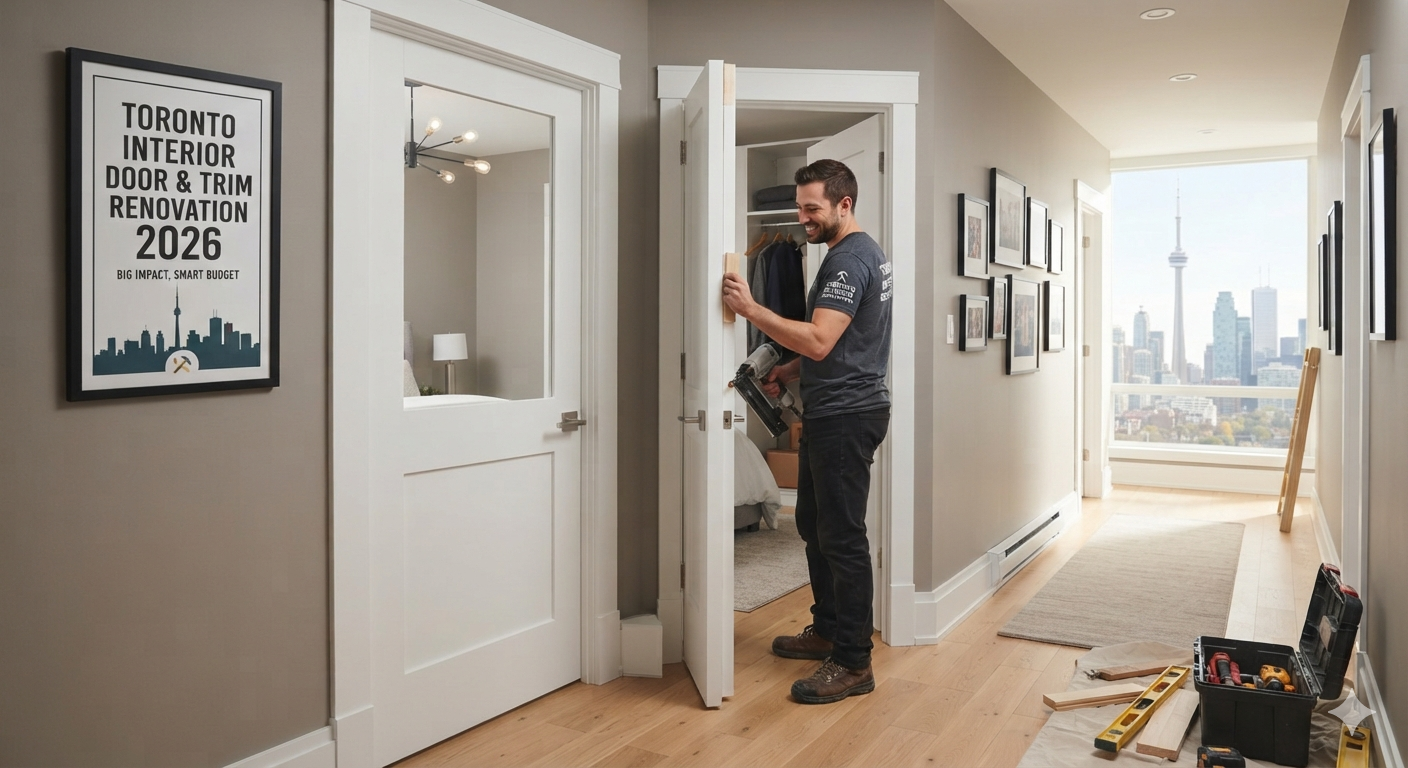
Most Toronto homeowners think about big renovation projects — kitchens, bathrooms, basements. But there’s a category of renovation that consistently delivers outsized visual impact at a fraction of the cost: interior doors and trim.
Walk through a home where builder-grade hollow-core doors have been replaced with solid-core panels, where tired 2-inch baseboards have been swapped for substantial 4-inch profiles, and where crisp new door casings frame every opening. The home feels more substantial, more finished, more thoughtfully designed — without a single wall being moved or a single fixture being replaced.
This is the “big impact, smart budget” renovation that too few Toronto homeowners explore before spending five figures on kitchen upgrades. In 2026, a complete interior door and trim refresh for a standard Toronto home typically costs $5,000–$12,000 — often less than a single bathroom renovation — and produces a transformation that affects every room in the house.
At David Reno, interior door and trim renovation is a core part of what we do — as a standalone project and as the finishing layer on every larger renovation we complete. This guide gives you real 2026 Toronto pricing across every door type, trim profile, and project scope, plus the decisions that most affect your result.
Table of Contents
- Cost Quick Reference — Interior Doors & Trim Toronto 2026
- Why Interior Doors & Trim Make Such a Big Difference
- Interior Door Types & Costs
- Door Hardware: Handles, Hinges & Locks
- Trim Types & Costs
- Painting Doors & Trim
- Whole-Home Project Cost Examples
- Factors That Affect Your Total Cost
- Installation Timeline
- How David Reno Can Help
- Tips to Save Money
- Frequently Asked Questions
Cost Quick Reference — Interior Doors & Trim Toronto 2026
| Item | Unit | Cost Range (Toronto 2026) | Notes |
|---|---|---|---|
| Hollow-Core Door | Per door (installed) | $350 – $700 | Door + jamb + casing + hardware + labour |
| Solid-Core Door | Per door (installed) | $550 – $950 | Significant feel and sound upgrade |
| French Doors (pair) | Per pair (installed) | $1,200 – $3,000 | Opening modification often required |
| Pocket Door | Per door (installed) | $900 – $2,200 | Wall modification required |
| Barn Door | Per door (installed) | $700 – $2,000 | Hardware track + wall mount |
| Bifold Closet Door | Per pair (installed) | $350 – $800 | Standard closet upgrade |
| Door Casing (trim around door) | Per linear foot | $5 – $12 | Both sides of door; standard door = 28–32 lf |
| Baseboards | Per linear foot (installed) | $4 – $10 | Removal of old baseboards included |
| Crown Moulding | Per linear foot (installed) | $8 – $22 | Higher on complex profiles and cathedral ceilings |
| Wainscoting / Wall Panels | Per linear foot | $25 – $65 | MDF panel or beadboard |
| Door & Trim Painting | Per door or per lf | $50–$120/door; $1–$2/lf trim | Brush-and-roll; spray finish extra |
Why Interior Doors & Trim Make Such a Big Difference
Interior trim — doors, casings, baseboards, crown moulding — is what interior designers call “the architecture of the room.” It’s the framework that defines how finished and intentional a space feels. And in Toronto’s housing stock, where the majority of homes built between 1960 and 2000 were outfitted with the minimum builder-grade trim package, there’s enormous opportunity.
Consider what happens when you upgrade:
- A hollow-core door replaced with solid-core — the moment you close it, the room feels quieter, more private, more substantial. Sound stops travelling between rooms the way it used to.
- 2-inch builder baseboard replaced with 4-inch profile baseboard — the room feels taller, more finished, more designed. It costs $600–$1,200 for a typical room and takes less than a day.
- Plain door openings fitted with proper casing — openings that used to look unfinished now look intentional. The wall-to-door transition is clean and architectural.
- Crown moulding added to a living room — the ceiling line anchors the room. One of the oldest architectural tricks in home design, and still one of the most effective.
These changes are especially powerful when combined with fresh paint — a standard two-coat repaint paired with new trim and doors is often the most transformative renovation a Toronto homeowner can do before selling.
Interior Door Types & Costs
Hollow-Core vs. Solid-Core Doors — $350 to $950 installed
This is the most important decision in any interior door project — and the one where the upgrade cost is smallest relative to the result.
| Hollow-Core | Solid-Core | Solid Wood (Hardwood) | |
|---|---|---|---|
| Construction | Cardboard honeycomb inside thin wood veneer | Dense composite or MDF core, wood veneer face | Real hardwood throughout |
| Weight | Light — easy to hang | Substantial — heavier hinges may be needed | Heavy — requires proper framing |
| Sound control | Minimal — sound passes easily | Good — noticeably quieter between rooms | Best — maximum sound isolation |
| Feel when closing | Hollow thud | Solid, quiet, satisfying | Premium, weighty |
| Durability | 10–15 years | 20–30 years | 30–50+ years |
| Installed cost (Toronto) | $350 – $700 | $550 – $950 | $900 – $1,800 |
David Reno’s recommendation: Upgrade to solid-core in bedrooms, bathrooms, home offices, and anywhere sound privacy matters. The $150–$250 premium per door is the best value-per-dollar upgrade in interior door renovation. Hollow-core is acceptable for closets and utility rooms where sound isn’t a concern.
French Doors — $1,200 to $3,000 per pair installed
French doors — paired glass-panel doors that open from the centre — are one of the most popular interior upgrades in Toronto homes. They maintain visual connection between rooms while providing a door that actually closes. Popular applications: home office to living room, dining room to kitchen, study to hallway.
| French Door Scenario | Cost (Installed) |
|---|---|
| Replacing existing double doorway (same size) | $1,200 – $2,000 |
| New French door in existing single-door opening (widening required) | $1,800 – $3,000 |
| New French door opening in a non-load-bearing wall | $2,500 – $4,500 |
| New French door in a load-bearing wall | $4,500 – $8,000+ (structural work required) |
Glass options: Clear glass (maximum light, visible into room), frosted glass (privacy with light transmission), reeded or fluted glass (decorative, partial privacy), or divided-light (classic French style, multiple glass panels).
Pocket Doors — $900 to $2,200 installed
Pocket doors slide into the wall cavity rather than swinging open — eliminating the door’s footprint from the room entirely. They’re increasingly popular in Toronto’s smaller homes and condos where door swing interferes with furniture placement. Common applications: ensuite bathrooms, pantries, home offices, laundry rooms.
| Pocket Door Scenario | Cost |
|---|---|
| Replace existing pocket door (hardware + door only) | $500 – $900 |
| New pocket door in non-load-bearing wall (new rough-in) | $900 – $1,600 |
| New pocket door in load-bearing wall | $2,500 – $5,000+ |
Important: Pocket door rough-in requires opening the wall to install the steel frame and track. This means drywall work on both sides of the wall — plan for patching, priming, and painting after installation. David Reno handles the full scope: rough-in, drywall, and finishing.
Barn Doors — $700 to $2,000 installed
Sliding barn doors (hardware track mounted above the door opening, door slides along it) have become a popular design statement in Toronto’s open-concept renovations. They work well where a pocket door isn’t feasible (not enough wall space for the pocket) but you don’t want a swinging door.
| Barn Door Type | Cost (Installed) |
|---|---|
| Standard barn door (basic hardware, MDF or pine) | $700 – $1,100 |
| Statement barn door (solid wood, quality hardware) | $1,100 – $1,800 |
| Double sliding barn door (bypass) | $1,400 – $2,500 |
Practical consideration: Barn doors need clear wall space equal to the door width on the slide side. A 32″ barn door needs 32″ of unobstructed wall beside the opening. Check your wall space before committing to this style — they don’t work in every location.
Bifold & Sliding Closet Doors — $350 to $900 per pair
Closet doors are often the last thing Toronto homeowners update — and one of the first things buyers notice. Builder-grade bifold doors with hollow panels and cheap hardware date a home significantly. Upgrading to full-panel bifold or sliding bypass closet doors with quality hardware is a quick, low-cost improvement.
| Closet Door Type | Cost Per Pair (Installed) |
|---|---|
| Basic bifold (hollow-core, standard sizes) | $350 – $550 |
| Solid-panel bifold (MDF, paintable) | $500 – $800 |
| Sliding bypass doors (2-panel) | $450 – $750 |
| Mirror sliding bypass doors | $600 – $1,000 |
Door Hardware: Handles, Hinges & Locks
Door hardware is a small cost item that has a disproportionate impact on the finished feel of a room. Mismatched, builder-grade handles undercut even the most beautiful door. Consistent, quality hardware throughout a home — all in the same finish — elevates every room.
| Hardware Category | Budget Option | Mid-Range | Premium |
|---|---|---|---|
| Door knob (passage) | $20 – $45 | $60 – $120 | $120 – $300+ |
| Door lever (passage) | $35 – $65 | $80 – $180 | $200 – $400+ |
| Privacy lever (bedroom/bathroom) | $45 – $80 | $90 – $200 | $220 – $450+ |
| Hinges (per set of 3) | $12 – $25 | $30 – $65 | $70 – $150+ |
| Door stop | $5 – $10 | $12 – $25 | $30 – $60+ |
Popular finishes in 2026: Matte black is the dominant trend in Toronto new builds and modern renovations. Brushed gold (champagne) is popular in warmer or transitional interiors. Satin nickel remains the classic neutral that works in almost every home. Avoid mixing finishes across rooms — consistency reads as intentional design.
Trim Types & Costs
Door Casing — $5 to $12 per Linear Foot Installed
Door casing is the trim that frames the door opening on both sides — the transition between the door jamb and the wall surface. In many Toronto homes, builder-grade casing is a simple flat 2¼-inch ranch-style profile that provides minimum coverage. Upgrading to a more substantial colonial, craftsman, or contemporary profile transforms the architectural presence of every doorway in the house.
| Casing Profile | Cost Per Linear Foot Installed | Style |
|---|---|---|
| Basic ranch (flat, 2¼”) | $5 – $7 | Builder-grade minimal |
| Colonial / traditional (stepped profile, 2½”–3″) | $6 – $9 | Classic, suits older Toronto homes |
| Craftsman (flat board with backband, 3″–3½”) | $7 – $11 | Modern and bungalow styles |
| Contemporary (wide flat profile, 3½”–4½”) | $8 – $12 | Modern and minimalist interiors |
| Custom / heritage (built-up profile) | $12 – $22+ | Heritage and character homes |
A standard interior door requires approximately 28–32 linear feet of casing (both sides of the door frame). At mid-range pricing ($7–$9/lf), casing one door costs $196–$288 — a very reasonable cost for the visual result.
Baseboards — $4 to $10 per Linear Foot Installed
Baseboards are the horizontal trim where walls meet floors — and arguably the single most impactful trim upgrade for the money in a Toronto home. Replacing 2½-inch builder baseboards with 4-inch or 5-inch profiles immediately makes ceilings feel higher and rooms feel more substantial.
| Baseboard Profile | Height | Cost Per Linear Foot | Style |
|---|---|---|---|
| Builder-grade (basic) | 2¼” – 2½” | $4 – $5 | Standard; common in GTA homes pre-2010 |
| Standard upgrade | 3½” – 4″ | $5 – $7 | Noticeable improvement, works in most homes |
| Mid-profile with cap | 4″ – 5″ | $6 – $8 | Traditional or transitional homes |
| Tall profile | 5″ – 6″ | $7 – $10 | High-ceiling rooms, premium look |
| Built-up baseboard (2-piece) | 6″ – 8″ | $10 – $16 | Heritage character, formal spaces |
Typical Toronto project sizes:
- Single room (12 × 14 ft): approximately 50 linear feet — $250–$500 installed
- Main floor (3 rooms + hallway): approximately 130–160 linear feet — $650–$1,600 installed
- Whole home (12 doors + full perimeter): approximately 300–400 linear feet — $1,200–$4,000 installed
Crown Moulding — $8 to $22 per Linear Foot Installed
Crown moulding runs along the junction of wall and ceiling, creating an architectural transition that adds formality and polish. It’s one of the oldest design elements in residential architecture and remains one of the most effective ways to elevate a room.
| Crown Moulding Type | Profile | Cost Per Linear Foot |
|---|---|---|
| Simple cove (single profile) | 2″ – 3″ | $8 – $11 |
| Standard crown (stepped) | 3″ – 4″ | $10 – $14 |
| Wide crown (traditional) | 4″ – 5½” | $12 – $18 |
| Built-up crown (2–3 piece) | 5″ – 8″ | $16 – $22+ |
Installation complexity: Crown moulding is more labour-intensive than baseboards because compound miter cuts are required at corners — the blade must be angled in two planes simultaneously. Vaulted or cathedral ceilings require specialized cuts and add 25–40% to labour cost. Outside corners (common in open-concept Toronto renovations) require precise coped or mitered returns.
Wainscoting & Wall Panels — $25 to $65 per Linear Foot
Wainscoting is panelling applied to the lower portion of a wall — typically 36–48 inches high — creating a visual division between the lower and upper wall. Wall panel grids (applied to the full wall or sections) have become an enormously popular 2026 trend in Toronto dining rooms, primary bedrooms, and entryways.
| Type | Cost Per Linear Foot | Notes |
|---|---|---|
| Beadboard wainscoting (MDF) | $25 – $40 | Classic cottage or country style |
| Flat panel (raised frame on flat MDF) | $30 – $50 | Most popular Toronto residential style |
| Board and batten | $25 – $45 | Vertical boards, simple modern look |
| Full-height panel grids (floor to ceiling) | $40 – $65 | Feature wall; very popular in 2026 |
Wall panels and wainscoting are painted after installation — factor in one coat of primer and two coats of paint for the best finish. Paint cost is additional: approximately $200–$500 for a feature wall depending on height and size.
Painting Doors & Trim
New doors and trim need paint or stain to look finished. This is where many door and trim renovation budgets run short — the trim looks unfinished and sits unpainted for months. Build paint into your project from the start.
| Painting Scope | Cost Range (Toronto 2026) | Notes |
|---|---|---|
| Single interior door (both sides, jamb, casing) | $50 – $120 | Brush-and-roll; 2 coats |
| All doors — full home (10–12 doors) | $500 – $1,200 | Per-door pricing drops on larger projects |
| Baseboards (brush-and-roll) | $1.00 – $2.00 per linear foot | Cutting in along floor and wall |
| Crown moulding (brush-and-roll) | $1.50 – $3.00 per linear foot | Cutting in at ceiling is more precise |
| Spray finish (doors, cabinets) | $80 – $200 per door | Factory-quality finish, harder, smoother — best for statement doors |
| Full trim repaint (whole home — all trim) | $2,500 – $5,000 | Doors + casing + baseboards + crown; 2–3 days |
Colour recommendation 2026: White remains the universal choice for trim in Toronto homes — pure white (Benjamin Moore Chantilly Lace, Sherwin-Williams Extra White) reads clean and crisp. Warm white (White Dove, Alabaster) suits warmer or more traditional interiors. Black doors as a contrast to white trim is a strong 2026 trend that works particularly well in transitional and modern homes.
Whole-Home Project Cost Examples
Small Toronto Home — Semi-Detached, 8 Interior Doors
Scope: Hollow-to-solid-core upgrade + new hardware + baseboard refresh
- 8 solid-core doors (replace hollow-core, same openings): $4,400 – $7,600
- Hardware upgrade (8 levers, matte black, mid-range): $640 – $1,440
- New door casing (8 doors × 30 lf × $7/lf): $1,680
- New baseboards (150 lf, 4″ profile, $6/lf): $900
- Painting (8 doors + all trim): $1,200 – $2,000
- Total: $8,820 – $13,620
Result: Every door in the house upgraded, hardware cohesive, casing refreshed, baseboards replaced. The home feels substantially more finished in every room.
Standard Detached Toronto Home — 12 Interior Doors
Scope: Full interior door & trim renovation — doors, hardware, casing, baseboards, crown moulding in living/dining
- 12 solid-core doors (installed): $6,600 – $11,400
- Premium hardware (12 sets, brushed gold): $1,440 – $2,160
- New door casing throughout (12 doors × 30 lf × $8/lf): $2,880
- New baseboards throughout (250 lf, 4½” profile, $7/lf): $1,750
- Crown moulding (living room + dining room, 80 lf, $13/lf): $1,040
- 1 set French doors (home office to living room, existing opening): $1,500 – $2,200
- Full trim painting (all doors, trim, crown): $2,500 – $4,000
- Total: $17,710 – $25,430
Result: A complete interior architectural refresh. Every opening, every surface transition, and every room perimeter is upgraded. This is the renovation that makes buyers think a home has been “recently fully renovated” even if the kitchen and bathrooms are the same.
Budget-Focused: Highest-Impact Items Only — $4,000 – $7,000
Scope: Maximum visual return for minimum spend
- Replace 3–4 most-used solid-core doors (bedrooms, main bathroom): $1,650 – $3,800
- New hardware throughout (all 10–12 doors, mid-range levers): $800 – $1,440
- New baseboards on main floor only (120 lf, $6/lf): $720
- Crown moulding in living room only (50 lf, $12/lf): $600
- Painting (doors + trim): $800 – $1,200
- Total: $4,570 – $7,760
Strategy: Hardware is visible on every door even if the door itself isn’t replaced. Upgrading hardware throughout the home ($800–$1,440 total) is the single best-value improvement on this list — every door handle you touch is upgraded, even in rooms where the door itself remains.
Factors That Affect Your Total Cost
1. Opening Size & Condition
On-site adjustments are common — some doors go in straight; others require trimming, hinge repositioning, or jamb shimming to function correctly. Older Toronto homes with settling or uneven framing often need more adjustment work per door. Budget $50–$150 per door for adjustment work in pre-1990 construction.
2. Existing Trim Removal
Removing old baseboards and casing adds labour time. In homes where trim was installed with construction adhesive (common post-2000), removal is more damaging to drywall — expect patching and touch-up. Budget $1–$2 per linear foot for removal and any drywall repairs needed.
3. Ceiling Height & Room Complexity
Crown moulding on 9-foot or 10-foot ceilings requires taller ladders and more precise cutting — adding 15–25% to labour. Cathedral ceilings require compound angle cuts that few carpenters execute cleanly without experience. Always confirm your contractor has worked with vaulted ceilings before quoting crown moulding on these spaces.
4. Door Size — Non-Standard Openings
Labour typically runs $100 to $500 per door depending on complexity. Standard 80″ × 32″ doors are the most affordable to replace — they’re pre-hung and widely available. Non-standard heights (84″, 96″) or widths require custom-ordered or custom-cut doors, adding lead time and cost. Toronto’s older housing stock frequently has non-standard rough openings — always measure before ordering.
5. Painting Finish Level
A brushed-on semi-gloss finish is standard for trim and adequate for most applications. Spray finish produces a smoother, factory-quality result — particularly noticeable on flat-panel doors. Spray finish adds $60–$120 per door but is worth it for high-visibility statement doors (black doors, feature entryways).
6. Number of Doors — Volume Efficiency
Replacing one door costs proportionally more than replacing ten. Door and trim projects have fixed mobilization costs (trip, setup, disposal) that are shared across the project. A 10-door replacement costs less per door than a 3-door replacement. If you’re considering a partial replacement, think about whether the additional cost to do the full home is worth it.
Installation Timeline
| Scope | Duration | Notes |
|---|---|---|
| Single door replacement (door + casing) | 2–4 hours | Straightforward existing opening |
| Full home re-door (10–12 doors) | 2–4 days | Doors, hardware, casing — no trim work |
| Baseboard replacement (whole home, 250 lf) | 2–3 days | Removal, installation, nail holes filled |
| Crown moulding (living/dining rooms) | 1–2 days | Cutting, fitting, nailing — caulking and fill |
| Full trim painting (all doors + trim, whole home) | 3–5 days | Prep, prime, two coats, dry time between |
| Complete door + trim renovation (whole home) | 5–10 days | Doors, casing, baseboards, crown, hardware, paint |
| French door or pocket door (new opening) | 2–4 days | Structural work, framing, drywall, finishing |
Important: The home is fully liveable throughout a door and trim renovation — this is interior finish work, not a structural project. Rooms are accessible while work is in progress in other areas, and there is no need for temporary accommodation.
How David Reno Can Help
Interior door and trim renovation is a core part of David Reno’s finish carpentry and interior renovation services. We handle every component — from door supply and installation through casing, baseboards, crown moulding, and painting.
Every major renovation David Reno completes — kitchen, bathroom, basement, home addition — ends with a door and trim finish pass. We understand how the final details define the quality of the project. And for clients who want a standalone door and trim transformation without a larger renovation, we deliver the same standard of craftsmanship.
What David Reno handles:
- On-site assessment: We measure every door opening, assess frame condition, and provide written fixed-price quotes — no surprises for frame repairs or adjustment work
- Door specification & supply: We source solid-core, French, pocket, and barn doors from our supplier network — you choose the style and finish
- Door installation: Hanging, shimming, adjusting — doors that close smoothly and latch properly in older Toronto homes with settling frames
- Hardware installation: All hardware installed, aligned, and tested — consistent finish throughout
- Casing installation: Custom profile casing cut precisely to each opening — clean mitered corners, no gaps
- Baseboard installation: Old baseboard removed, new baseboard fitted — including scribe cuts for out-of-plumb walls (very common in older Toronto homes)
- Crown moulding: Compound miter cuts, coped corners, consistent reveal — this is skilled work we execute on every project
- Drywall repairs: Any damage from baseboard removal patched and ready for paint
- Painting: We can include a full trim paint pass as part of the project or leave primed and ready for your own painter
- Written warranty: All David Reno work is warranted in writing
Tips to Save Money on Interior Doors & Trim
1. Upgrade Hardware First
If budget is tight, start with hardware. A consistent set of quality levers throughout the home costs $800–$1,500 and upgrades every door you touch — even if the doors themselves haven’t changed. It’s the fastest, most visible impact for the smallest investment.
2. Upgrade Solid-Core in Bedrooms & Bathrooms Only
Sound isolation matters most in bedrooms, bathrooms, and home offices. Closet doors and utility room doors can remain hollow-core without meaningful impact. Strategic solid-core upgrades cost 30–40% less than a full-home replacement.
3. Start with Baseboards
If you can only do one trim upgrade, do baseboards. They run continuously through every room and have more visual impact per dollar than any other trim element. New 4-inch baseboards throughout a main floor cost $650–$1,600 and transform the space.
4. Combine with Adjacent Renovations
Door and trim work combined with another David Reno project (bathroom, basement, open concept) shares mobilization, trades scheduling, and disposal costs. Adding trim work to a bathroom renovation adds far less in proportional cost than doing it as a standalone project.
5. Buy Doors in Standard Sizes
Standard 80″ × 30″ or 80″ × 32″ doors are widely stocked and significantly cheaper than custom sizes. If an opening is close to standard size, reframing to standard is often cheaper than ordering custom. Confirm sizing before purchase.
6. Paint Yourself
Painting trim is the one part of this project that motivated DIYers can execute well with patience and the right tools (quality angled brush, semi-gloss paint, painter’s tape). Saving $1,500–$2,500 on trim painting leaves more budget for the finish carpentry — where professional installation makes the most visible difference.
Frequently Asked Questions
How much does interior door replacement cost in Toronto in 2026?
Interior door replacement in Toronto costs $350–$700 per door for a standard hollow-core door fully installed (door, hardware, casing, labour), or $550–$950 for a solid-core upgrade. Labour for a standard interior door swap runs $100–$300 per door in Toronto — slightly higher than smaller Ontario markets due to GTA wage rates. A full 10–12 door project for a typical Toronto home costs $4,500–$12,000 depending on door type, hardware grade, and whether trim work is included.
Is solid-core worth the upgrade from hollow-core?
Yes — consistently. The difference in sound isolation, weight, and feel is immediately noticeable. The premium is typically $150–$250 per door. For bedrooms, bathrooms, and home offices where privacy matters, solid-core is the standard David Reno recommends. For closets and utility rooms, hollow-core remains adequate.
How much do new baseboards cost in Toronto?
Baseboard installation in Toronto costs $4–$10 per linear foot installed, including removal of existing baseboards. A standard Toronto room (12 × 14 ft) has approximately 50 linear feet of baseboard perimeter — costing $250–$500 installed. A main floor refresh (3 rooms + hallway, 150 lf) costs $750–$1,500. Painting is additional.
Do I need a permit for interior door or trim work in Toronto?
Replacing a door in an existing opening with a unit of the same size generally does not require a permit in most Canadian municipalities. No permit is needed for like-for-like interior door replacement, baseboard, or trim installation. A permit is required if you’re creating a new opening in a wall (especially load-bearing), widening an existing opening, or if structural work is involved. David Reno confirms permit requirements at the estimate visit for any project involving wall modifications.
How long does a whole-home door and trim renovation take?
A complete door and trim renovation — all doors, hardware, casing, and baseboards throughout a typical Toronto home — takes approximately 5–10 business days. Adding crown moulding or wainscoting adds 1–3 more days. Painting is typically done last and adds 3–5 days. The home is fully liveable throughout — this is interior finish work, not structural.
What’s the best door colour for Toronto homes in 2026?
Black interior doors are the single most popular statement door choice in Toronto’s renovated homes in 2026 — they work in modern, transitional, and even traditional interiors when the trim is white. Classic white (semi-gloss or satin) is the safe, universally appealing choice for doors that blend rather than feature. Natural wood stain finishes are making a comeback in Craftsman and warm modern interiors. Choose based on your overall interior palette — doors should complement the trim and wall colours, not fight them.
Transform Every Room in Your Toronto Home — Without a Major Renovation
New solid-core doors, cohesive hardware, proper casing, and fresh baseboards throughout your home. It affects every room you live in, takes less than two weeks, and costs a fraction of what a kitchen or bathroom renovation runs.
David Reno handles interior door and trim renovation across Toronto and the GTA — supply, installation, and finishing work delivered with the same craftsmanship we bring to every project. Written quote, fixed price, labour warranty.
We serve North York, Scarborough, Etobicoke, Leaside, Roncesvalles, Bloor West Village, The Beach, Mississauga, Markham, and all of Toronto and the GTA.
🚪 Call us today: (647) 463-2246
📧 Email: info@davidreno.ca
📍 Serving all of Toronto & GTA
⚡ Fall is the ideal time for interior renovation — book your estimate today.