
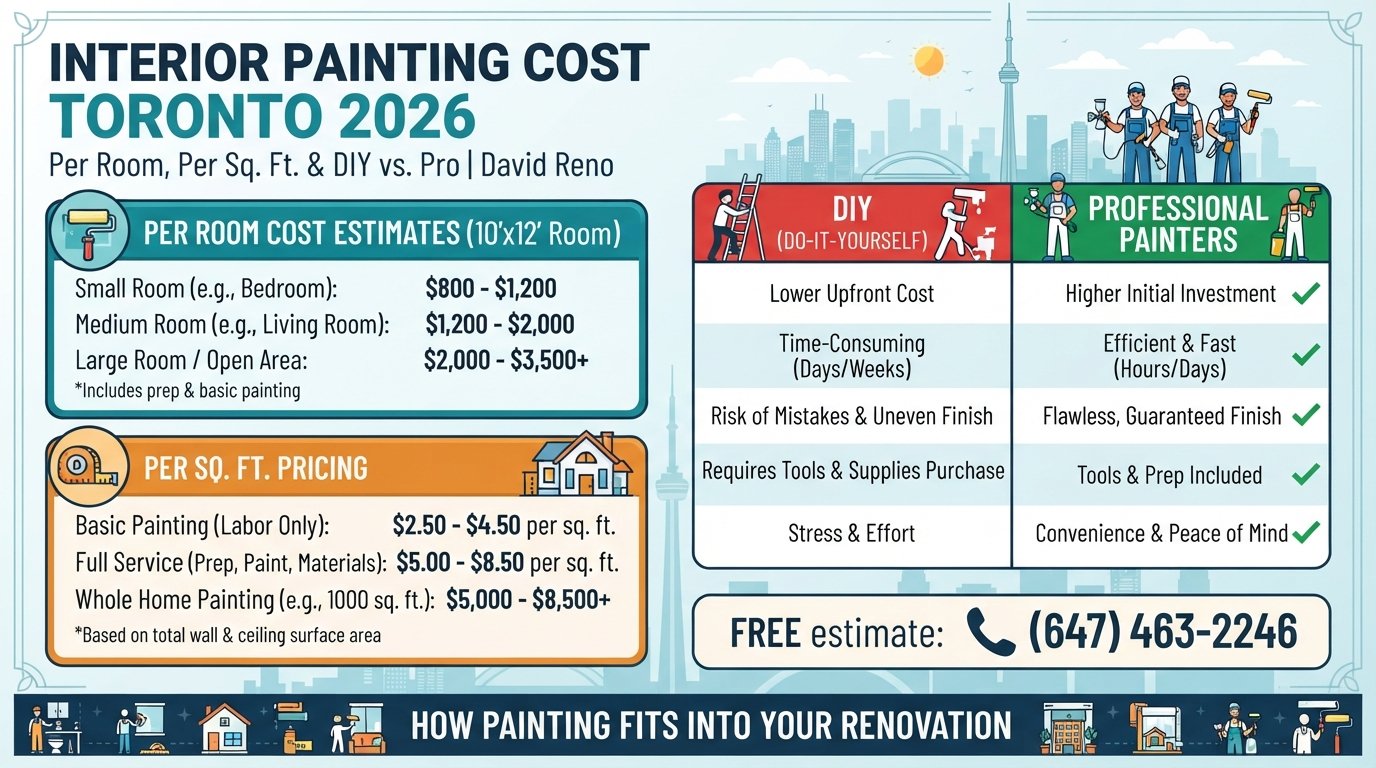
Interior painting is the most popular home improvement project in Canada — and the one with the widest gap between what homeowners expect to pay and what professional painters actually charge in Toronto. Toronto and Vancouver sit 15 to 25% above national average painting rates, reflecting GTA labour costs and the density of renovation activity in the market. A quote that looks high compared to a national pricing guide is usually accurate for Toronto.
Paint is also the renovation finish that makes or breaks everything else. New cabinetry, fresh trim, and a beautifully tiled bathroom all look better — or worse — depending on the quality of the paint job surrounding them. It’s the last thing that goes on and the first thing people see. Getting it right matters.
This guide gives you real 2026 Toronto pricing by room, by square foot, and by project scope. It covers the DIY vs. professional comparison honestly — including where DIY makes sense and where it doesn’t. And it explains how painting fits into a larger renovation sequence, because painting at the wrong stage of a project is one of the most expensive and avoidable mistakes Toronto homeowners make.
At David Reno, painting is the finishing layer on every renovation we complete. We coordinate professional painting as part of kitchen, bathroom, basement, and whole-home renovation projects — and we understand exactly when and how paint fits into the renovation sequence for the best result.
Table of Contents
- Interior Painting Cost Quick Reference — Toronto 2026
- Cost by Room Type
- Trim, Ceilings & Doors
- Whole-Home Painting Cost
- DIY vs. Professional: The Honest Comparison
- Paint Quality Guide: What the Price Difference Means
- Prep Work — The Step That Determines the Result
- 2026 Colour Trends for Toronto Homes
- Painting in a Renovation — Sequence Matters
- Factors That Affect Your Total Cost
- Tips to Save Money
- How David Reno Can Help
- Frequently Asked Questions
Interior Painting Cost Quick Reference — Toronto 2026
| Scope | Cost Range (Toronto 2026) | Notes |
|---|---|---|
| Per sq. ft. — walls only | $2.00 – $3.50 | Two coats, standard prep |
| Per sq. ft. — walls + ceiling + trim | $3.50 – $5.50 | Full room package |
| Bedroom (10×12 ft) | $400 – $900 | Walls, ceiling, trim; standard 8 ft ceiling |
| Living / dining room | $600 – $1,400 | Open-concept rooms price higher |
| Kitchen (walls only, no cabinets) | $500 – $1,200 | Many obstacles = more time |
| Bathroom | $300 – $700 | Small area, high prep (moisture resistance) |
| Basement (open, unfinished ceiling) | $800 – $2,500 | Exposed joists add complexity |
| Hallway + staircase | $600 – $1,500 | High walls, difficult access = premium |
| Interior door (per door, both sides) | $80 – $180 | Brush or spray; includes jamb and casing |
| Trim / baseboards (per linear foot) | $1.50 – $3.50 | Cut-in, brush finish, two coats |
| Crown moulding (per linear foot) | $2.00 – $4.00 | Two cut-in lines; more time than baseboards |
| Full-house interior (1,500–2,000 sq ft home) | $4,500 – $9,000 | Walls, ceilings, trim, doors throughout |
| Painter hourly rate (Toronto) | $45 – $75/hr | Some painters quote hourly; most quote by room or project |
Cost by Room Type
Bedroom — $400 to $900
To get accurate rates, six Toronto painting professionals were asked to estimate a quote for a 10’×12′ bedroom with 8′ ceilings. Quotes ranged, highlighting that prep work, number of coats, and trim inclusion are the main variables between low and high estimates.
| Bedroom Size | Walls Only | Walls + Ceiling + Trim |
|---|---|---|
| Small (10×10 ft) | $350 – $550 | $500 – $750 |
| Standard (10×12 ft) | $400 – $650 | $580 – $900 |
| Large master (14×16 ft) | $550 – $850 | $750 – $1,200 |
| Add closet interior (painted) | +$100 – $200 | |
| Add accent wall (different colour) | +$80 – $150 | |
What’s included at the standard price: Wall prep (fill nail holes, light sanding), two coats on walls, ceiling (one colour), baseboards and door casing, and cleanup.
Living Room / Dining Room — $600 to $1,400
Living and dining rooms tend to price higher per square foot than bedrooms because of feature walls, higher ceilings, more trim detail, and the greater visibility standard that clients apply to these spaces. Open-concept living rooms combined with dining rooms are priced as a single space — the continuous ceiling and floor-to-ceiling trim add cost.
| Scenario | Cost |
|---|---|
| Standard living room (12×16 ft, 8 ft ceiling) | $600 – $950 |
| Living + dining open-concept (larger footprint) | $900 – $1,400 |
| 9 or 10 ft ceilings (add per room) | +$150 – $350 |
| Crown moulding painting (50 lf) | +$100 – $200 |
| Fireplace surround painting | +$150 – $400 |
Toronto trend note: Two-tone walls — a single darker accent wall behind the sofa or TV, with lighter walls on the remaining three sides — add $80–$150 to the room price but are one of the most requested paint upgrades in Toronto living rooms in 2026.
Kitchen — $500 to $1,200
Kitchens are among the most labour-intensive rooms to paint per square foot, despite having less wall area than bedrooms. Upper cabinets limit roller access. Backsplash areas require careful masking. The range and fridge require protection. Every edge requires precise cutting-in.
| Kitchen Scope | Cost |
|---|---|
| Walls only (above cabinets, visible areas) | $500 – $900 |
| Walls + ceiling | $700 – $1,200 |
| Cabinet painting (existing boxes, new colour) | $1,500 – $4,500 |
| Cabinet spray finish (professional, factory-like) | $2,500 – $6,000 |
Bathroom — $300 to $700
Bathrooms are small but require more prep and higher-quality paint than other rooms. Moisture resistance is non-negotiable — standard paint applied in a bathroom will peel and mould within 1–2 years. Professional painters specify bathroom-rated semi-gloss or satin with mould-inhibiting additives.
| Bathroom Type | Cost |
|---|---|
| Powder room / half bath | $300 – $500 |
| Standard full bathroom | $400 – $650 |
| Ensuite / larger bathroom | $500 – $750 |
| Bathroom ceiling (paint separate from walls) | +$80 – $150 |
Note on new bathroom renovation painting: After a bathroom renovation (new drywall, tile, trim), a proper priming and paint pass is essential before the project is considered complete. New drywall requires a primer coat before finish paint — skipping this produces an uneven finish that no amount of extra finish coats will fully correct.
Basement — $800 to $2,500
Basement painting varies enormously depending on whether the basement is finished, unfinished, or in transition. An unfinished basement with exposed concrete walls and open joists prices differently from a drywalled finished basement.
| Basement Scenario | Cost |
|---|---|
| Unfinished — paint concrete walls (waterproofing paint) | $800 – $1,800 |
| Unfinished — paint ceiling/joists black or grey | $600 – $1,500 |
| Finished basement (drywalled, 600–800 sq ft) | $1,200 – $2,500 |
| Staircase and landing | $400 – $800 |
Exposed joist ceiling painting: Painting basement ceiling joists, pipes, and ducts black is one of the most popular basement design choices in Toronto in 2026 — it creates an industrial aesthetic, avoids the cost of a dropped ceiling, and keeps basement ceiling height. It’s labour-intensive (spraying is far more practical than rolling) and requires careful masking of walls and floor.
Hallway, Staircase & Foyer — $600 to $1,500
Hallways and staircases are the most underestimated painting scope in Toronto homes. Staircase walls are tall, require ladder and scaffolding work on angled surfaces, and the continuous run makes uniform finish quality difficult. In Toronto’s multi-storey semi-detached and detached homes, the central staircase from main floor to second floor is often the most technically demanding interior painting scope in the house.
| Scope | Cost |
|---|---|
| Main floor hallway (standard) | $300 – $600 |
| Full staircase (main to second floor) | $500 – $1,000 |
| Foyer with high ceiling (12 ft+) | $600 – $1,200 |
| Combined hallway + staircase + landing | $800 – $1,500 |
Trim, Ceilings & Doors
| Element | Unit | Cost (Toronto 2026) | Notes |
|---|---|---|---|
| Ceiling (standard room) | Per room | $100 – $300 | Flat or eggshell finish; 8 ft height |
| Ceiling (9–10 ft, or with crown) | Per room | $200 – $450 | More cut-in time at moulding |
| Baseboards | Per linear foot | $1.50 – $3.00 | Two coats semi-gloss; cut-in at floor |
| Door casing (per opening) | Per door | $40 – $90 | Both sides of frame |
| Interior door (both sides + jamb) | Per door | $80 – $180 | Brush; spray finish adds $50–$80/door |
| Crown moulding | Per linear foot | $2.00 – $4.00 | Two cut-in lines; ceiling + wall |
| Window trim (per window) | Per window | $50 – $120 | Sill, casing, and surround |
| Full trim repaint (whole home) | Whole home | $2,500 – $5,000 | All doors, casing, baseboards, crown — 2-3 days |
Trim finish choice matters: Trim is almost always painted in semi-gloss or satin — both are easier to wipe clean than flat paint and hold up better along baseboards and doors where contact is frequent. Using the same sheen on all trim throughout the home creates visual consistency. Switching between matte walls and semi-gloss trim is the standard approach for a reason: the contrast makes trim lines crisp and clean.
Whole-Home Painting Cost
Small Semi-Detached (3 bedrooms, 1,200 sq ft)
- 3 bedrooms (walls + ceiling + trim): $1,500 – $2,400
- Living/dining room (walls + ceiling): $700 – $1,100
- Kitchen (walls + ceiling): $600 – $1,000
- 2 bathrooms: $700 – $1,200
- Hallway + staircase: $600 – $1,000
- All interior doors (8 doors): $640 – $1,440
- Total: $4,740 – $8,140
Standard Detached (4 bedrooms, 1,800 sq ft, 9 ft ceilings)
- 4 bedrooms (walls + ceiling + trim, 9 ft): $2,400 – $4,000
- Living/dining open-concept: $900 – $1,400
- Kitchen: $700 – $1,200
- 3 bathrooms: $1,050 – $1,800
- Hallway + staircase (multi-level): $800 – $1,500
- Crown moulding (main floor, 120 lf): $240 – $480
- All interior doors (12 doors): $960 – $2,160
- Total: $7,050 – $12,540
Condo (2 bedroom + den, 900 sq ft)
- 2 bedrooms + den (walls + ceiling): $1,100 – $1,800
- Living/dining/kitchen open-concept: $700 – $1,100
- 1–2 bathrooms: $500 – $900
- Hallway: $200 – $400
- All doors (6 doors): $480 – $1,080
- Total: $2,980 – $5,280
- Note: Condo building fees, elevator booking, and waste removal rules add $200–$500 to project cost.
DIY vs. Professional: The Honest Comparison
| DIY | Professional | |
|---|---|---|
| Cost (materials only) | $200 – $600 (materials for standard home) | $4,500 – $9,000 (fully finished) |
| Time (standard 3-bedroom home) | 4 – 8 weekends | 3 – 5 days |
| Cut-in quality (ceiling/trim lines) | Variable — depends heavily on skill and patience | Consistent — experienced eye and technique |
| Prep work (patching, sanding) | Often underestimated or skipped | Included — professional standard prep |
| Paint application rate | Often too thick or too thin; uneven coverage | Correct coverage rate for lasting finish |
| Results on trim and doors | Difficult — brush marks, drips common | Clean, consistent, spray finish available |
| Clean up and masking | Time-consuming and easy to rush | Included, professional drop cloths throughout |
| Best for | Simple rooms, accent walls, touch-ups | Full homes, after renovation, ceilings, trim |
When DIY Makes Sense
- Single bedroom or bathroom repaint — contained scope, acceptable if not perfect
- Accent wall — one wall, no cut-ins at ceiling moulding
- Basement walls (concrete, rough texture) — finish standard is lower
- Touch-up work after minor repairs
- You have time, patience, and have painted rooms before
When Professional Is Worth Every Dollar
- After any renovation — new drywall, new trim, or new tile needs a proper primer and finish pass that shows the work at its best
- Ceilings — overhead painting is the most physically demanding scope and the most visible if done unevenly
- Crown moulding — two cut-in lines at different angles; most DIYers don’t achieve clean results here
- Staircases and high-ceiling foyers — access is challenging and dangerous without proper staging
- Spray-finish cabinets or doors — spray equipment and technique are professional skills
- Full-home repaint before selling — buyer perception of quality is directly tied to paint finish quality
Paint Quality Guide: What the Price Difference Means
Labour makes up 70–80% of most room painting quotes. That means paint quality — the remaining 20–30% — matters more than many homeowners realize. Cheap paint requires more coats, covers less evenly, and doesn’t last as long. Premium paint applied by a professional painter delivers results that budget paint never matches, regardless of technique.
| Paint Tier | Price per Gallon (2026) | Coverage | Recommended For |
|---|---|---|---|
| Budget (generic, private label) | $25 – $45 | 350 – 400 sq ft/gallon | Rental properties, utility rooms, touch-ups only |
| Mid-range (Benjamin Moore Regal, SW SuperPaint) | $55 – $75 | 380 – 450 sq ft/gallon | Standard residential rooms, bedrooms, living areas |
| Premium (BM Aura, SW Emerald, Farrow & Ball) | $75 – $120+ | 400 – 500 sq ft/gallon | Main living spaces, trim, anywhere finish quality is noticed daily |
Sheen Selection Guide
| Sheen | Appearance | Durability | Best For |
|---|---|---|---|
| Flat / Matte | No sheen, hides imperfections well | Low — marks and hard to clean | Adult bedrooms, low-traffic ceilings |
| Eggshell | Very slight sheen, elegant | Good — wipeable | Living rooms, dining rooms, most walls |
| Satin | Soft sheen, noticeable on flat surfaces | Very good — cleans easily | Hallways, kitchens, family rooms, kids’ rooms |
| Semi-Gloss | Clear sheen, reflects light | Excellent — most durable | Trim, baseboards, doors, bathrooms, kitchens |
| Full Gloss | High reflective sheen | Highest — shows every imperfection | Accent features, furniture, exterior doors |
Prep Work — The Step That Determines the Result
The quality of a paint job is determined 80% by preparation and 20% by application. A professional painter who spends the right time on prep produces a result that lasts 8–12 years. A DIYer who skips prep produces a result that looks acceptable for 18 months and then needs redoing.
| Prep Task | Why It Matters | Add-on Cost |
|---|---|---|
| Filling nail holes and minor cracks | Holes read as shadows under paint; fill first | $25 – $75 per room (usually included) |
| Sanding repaired areas | Unsanded filler shows as texture bumps | Included in standard prep |
| Priming new drywall | New drywall absorbs finish paint unevenly without primer | $0.50 – $1.00/sq ft additional |
| Stain-blocking primer (water stains, markers) | Stains bleed through finish paint without isolation | $50 – $150 per room |
| Caulking gaps (trim-to-wall joints) | Gaps read as shadow lines; caulked joints look seamless | $50 – $150 per room (sometimes included) |
| Washing walls (smoke, grease, chalk) | Paint won’t adhere properly to contaminated surfaces | $80 – $200 per room |
| Skim coating (level 5 drywall finish) | For premium finish quality or uneven surfaces | $1.50 – $3.50/sq ft additional |
2026 Colour Trends for Toronto Homes
The all-white home is retreating across Toronto. After a decade of white walls, grey walls, and greige walls, 2026 is bringing back warmth, character, and intentional colour choices.
| Colour Direction | Popular Choices (2026) | Best Application |
|---|---|---|
| Warm whites | BM White Dove, SW Alabaster, BM Chantilly Lace | Trim throughout; walls in light-limited rooms |
| Warm neutrals | BM Pale Oak, SW Accessible Beige, BM Edgecomb Gray | Living rooms, bedrooms — replaces cool greys |
| Sage green | BM Sage, SW Rosemary, F&B Mizzle | Kitchens, bathrooms, bedrooms — very popular 2026 |
| Deep moody tones | BM Hale Navy, SW Urbane Bronze, F&B Railings | Accent walls, home offices, powder rooms |
| Earthy terracotta / clay | BM Yosemite Sand, SW Cavern Clay | Dining rooms, feature walls |
| Black doors | BM Onyx, SW Tricorn Black, F&B Pitch Black | Interior doors against white trim — very popular |
Painting in a Renovation — Sequence Matters
Painting at the wrong stage of a renovation is one of the most common and most expensive mistakes Toronto homeowners make. It’s not just inconvenient — it results in damaged paint that needs redoing, wasted money, and a finished product that never looks quite right.
The Correct Renovation Paint Sequence
Every David Reno renovation follows this paint sequencing — it’s non-negotiable for achieving a finished result that looks like it was designed that way:
- Structural and mechanical work complete — walls closed, no more trades cutting drywall or drilling
- Drywall taping and mudding complete — surfaces level, all joints finished to Level 4 or 5
- Trim installed (new baseboards, door casing, crown moulding) — all nail holes present
- Primer coat on all new surfaces — particularly new drywall, which requires sealing before finish paint
- Ceiling painted first — drips fall on unpainted or primed walls
- Walls painted — two finish coats after spot-priming any repairs
- Trim painted last — caulk trim-to-wall gaps, then finish paint; done last because trim paint smudges if brushed against wet walls
- Flooring installed — after painting; painted trim on unpainted baseboard looks wrong; also, paint drips on new flooring is an expensive problem
- Final hardware and fixtures installed — door handles, switch plates, outlet covers
The most common sequence mistake: Installing new flooring before painting trim. Paint invariably gets on the new floor, baseboards get dinged during flooring installation, and the result is a trim repaint after flooring is installed — an inefficient and expensive sequence.
Painting After Specific Renovations
| Renovation Type | Painting Scope Required | Typical Add-on Cost |
|---|---|---|
| Bathroom renovation | Walls (moisture-resistant), ceiling, trim repaint | $500 – $900 |
| Kitchen renovation | Walls above and around cabinets, ceiling | $600 – $1,200 |
| Basement finishing | Full basement — walls, ceiling (drywall or exposed joists), trim | $1,200 – $3,000 |
| Open-concept wall removal | New drywall patch-and-prime + repaint entire affected zone | $800 – $1,800 |
| New trim installation (whole home) | Full trim repaint + adjacent wall touch-up | $2,500 – $5,000 |
| Home addition (new room) | Full new room paint — prime + two finish coats | $600 – $1,500 per room |
Factors That Affect Your Total Cost
1. Ceiling Height
Walls taller than 10 feet can increase the cost per square foot by $0.75–$1.25. Walls that extend 14 ft or more in height can add an extra $1.50–$2.25 per square foot. Toronto’s growing number of 9 and 10 ft ceiling homes (common in homes built or renovated post-2000) carry a meaningful premium over standard 8 ft ceiling pricing.
2. Number of Colours and Colour Changes
Each colour change between adjacent surfaces requires careful masking and edge work. An accent wall in a bedroom adds $80–$150 to the room. A two-tone room (upper/lower wall divided by chair rail) can add $150–$300. More colours mean more masking time and more edge work — both add to labour cost.
3. Surface Condition
Smooth, primed new drywall is the easiest surface to paint. Textured walls (orange peel, skip-trowel) require more paint. Previously-painted surfaces in poor condition (peeling, multiple old colours showing, heavy wall anchors) require significantly more prep time. Old popcorn texture removal (before painting smooth) adds $1.50–$3.50/sq ft to the scope.
4. Volume Discount
A bedroom and a hallway in one session costs less per room than two separate bookings. Painters have setup, masking, and cleanup time that’s shared across the whole project — a 10-room house booked together costs less per room than 10 single-room bookings over 10 visits. If multiple rooms need painting, do them together.
5. Furniture and Access
Professional painters typically move small furniture to the room’s centre and cover it. Heavy furniture (pianos, large bookshelves) that cannot be moved requires careful masking and restricts roller access — adding time to the quote. Empty rooms paint faster and cheaper than fully furnished rooms.
Tips to Save Money on Interior Painting
1. Book Multiple Rooms Together
The single most effective way to reduce per-room cost is to book all rooms in one project. A painter on-site for 3 days paints more efficiently per room than three single-day visits. If two or three rooms are due for painting, do them all at once.
2. Do the Prep Yourself
Filling nail holes, sanding, and wiping walls before the painter arrives reduces their prep time — often the most time-consuming part. Ask the painter what they want done before they arrive; some will reduce their quote for pre-prepped surfaces.
3. Choose the Right Time of Year
Professional painting prices are lowest in winter months. January and February are the slowest months for Toronto painters. Booking interior painting in winter often means better availability, more flexible scheduling, and sometimes off-peak pricing.
4. Use Premium Paint — It Saves Money Long-Term
Budget paint at $30/gallon that needs three coats costs more in labour than premium paint at $80/gallon that covers in two. Since labour is 70–80% of the total, using premium paint with better coverage reduces the total cost of two-coat coverage — and the paint lasts longer between repaints.
5. Paint After Renovation Work Is Completely Done
Painting before trades are fully finished means touchups, or worse, repainting. Coordinate with your contractor to confirm that all drywall, trim, and carpentry work is 100% complete before the painter arrives. Partial painting followed by touch-ups always costs more than one complete pass.
6. Save Ceilings for Professional — Do Walls Yourself
If budget is a constraint, have a professional paint ceilings and trim (the hardest surfaces with the most visible errors), and paint walls yourself. Walls are far more forgiving for a careful DIYer than ceilings or trim lines.
How David Reno Can Help
David Reno coordinates professional painting as a standard component of every renovation project we complete. We work with a consistent team of professional painters who understand the renovation sequence and deliver finish-quality results that make every project look its best.
- Post-renovation painting coordination: We schedule painting at the correct stage — after all trades, before flooring and hardware. No repainting because a trade came back after paint was done.
- New drywall priming: All new drywall surfaces properly primed before finish paint — non-negotiable for a consistent finish.
- Trim and door painting: Including spray finish for cabinet or door painting where the quality difference justifies it.
- Colour consultation: Our team can advise on colour choices that work with your renovation’s material palette — cabinetry, flooring, tile, and trim.
- Basement ceiling painting: Exposed joist ceilings sprayed black or dark grey — a popular and cost-effective alternative to a dropped drywall ceiling in Toronto basements.
- Standalone painting projects: Even without a larger renovation, David Reno can coordinate a full-home repaint through our painting team — proper prep, right sequence, quality result.
Frequently Asked Questions
How much does interior painting cost in Toronto in 2026?
Toronto painting costs $2.00–$4.50 per square foot of wall surface — 15–25% above the national average. Per room: bedrooms run $400–$900; living rooms $600–$1,400; kitchens $500–$1,200; bathrooms $300–$700. A full-home repaint for a standard 3-bedroom Toronto semi-detached costs $4,500–$8,000 including walls, ceilings, trim, and doors. Labour accounts for 70–80% of total cost.
Should I hire a professional painter or DIY in Toronto?
For ceilings, trim, staircases, and any painting done as part of a renovation — hire a professional. For simple bedroom or bathroom walls where minor imperfections are acceptable, confident DIYers can save money. The hybrid approach — professional for ceilings and trim, DIY for bedroom walls — delivers good results at moderate cost. After a renovation involving new drywall or trim, professional painting is strongly recommended: new surfaces require proper priming and application technique to look finished rather than freshly renovated.
How long does interior painting take in Toronto?
A standard bedroom takes 4–6 hours for a professional. A standard living room takes 5–8 hours. A full 3-bedroom Toronto home takes 3–5 days for a 2-person crew. Prep work (filling, sanding, priming) accounts for 30–40% of that time on a typical project.
What is the best paint for Toronto homes in 2026?
For walls: Benjamin Moore Aura or Sherwin-Williams Emerald in eggshell or satin — premium coverage, durable, and available in every colour. For trim and doors: Benjamin Moore Advance or Sherwin-Williams Emerald Urethane in semi-gloss — hard-wearing finish that cleans easily and doesn’t yellow. For bathrooms: any of the above with a mould-resistant formulation (available in both brands), in satin or semi-gloss finish. For basement concrete walls: a masonry waterproofing paint (Drylok or equivalent) as a first coat, then latex over top if desired.
When should I paint during a renovation?
After all drywall, trim, and carpentry work is completely done — and before flooring and hardware are installed. This is the correct sequence: structural → mechanical → drywall → trim → prime → paint ceilings → paint walls → paint trim → flooring → hardware. Painting at the wrong stage means either working around unfinished construction or repainting after trades disturb finished surfaces. David Reno manages this sequence on every project.
Ready to Refresh Your Toronto Home — from Renovation Finish to Full Repaint?
Paint is the finish that brings every renovation together — and the refresh that transforms a home that hasn’t changed in a decade. Done right, with proper prep and the right materials in the right sequence, a professional paint job lasts 8–12 years and makes every room in your home feel intentional and well-maintained.
David Reno coordinates professional painting as part of every renovation project across Toronto and the GTA — and as a standalone service for homes ready for a full refresh. We handle the sequence, the prep, the primer, and the finish. You get a result that looks like the renovation was designed, not assembled.
We serve North York, Scarborough, Etobicoke, Leaside, Roncesvalles, Bloor West, East York, The Beach, Mississauga, Markham, Richmond Hill, and all of Toronto and the GTA.
🖌️ Call us today: (647) 463-2246
📧 Email: info@davidreno.ca
📍 Serving all of Toronto & GTA
⚡ Winter is the best time to book interior painting — better availability and scheduling from Toronto’s best painters.