
August in Toronto is the best time to think about your windows — not because summer is ending, but because the warning signs are impossible to ignore. You feel the draft near the frame. You notice condensation between the glass panes on cooler mornings. You hear the street noise that used to be quieter. These are all signs that your windows are past their service life — and that you’ll feel the consequences in your heating bill every month from October through April.
Window replacement is one of the highest-ROI upgrades a Toronto homeowner can make before winter arrives. New energy-efficient windows reduce heat loss, eliminate drafts, prevent moisture damage to frames and walls, and can meaningfully reduce your natural gas bill. Active Ontario rebate programs can offset a portion of the cost — but only if you understand which programs are actually open in 2026 (several well-known programs have quietly closed).
At David Reno, we replace windows across Toronto and the GTA as part of our home renovation and envelope improvement services. We handle the full installation — old window removal, frame preparation, new window fitting, interior and exterior trim, caulking, and cleanup. This guide gives you real 2026 Toronto pricing, an honest double vs. triple pane comparison, and an accurate picture of what rebates you can actually claim today.
Table of Contents
- Window Replacement Cost Quick Reference — Toronto 2026
- Signs Your Windows Need Replacing
- Cost by Window Style
- Frame Materials: Vinyl, Fiberglass & Wood
- Double Pane vs. Triple Pane: The Honest Comparison
- Energy Star, Low-E & Argon — What They Mean
- Retrofit vs. Full-Frame Installation
- Whole-Home Project Cost Examples
- Ontario Window Rebates 2026: What’s Active, What’s Closed
- Factors That Affect Your Total Cost
- Installation Timeline
- How David Reno Can Help
- Tips to Save Money
- Frequently Asked Questions
Window Replacement Cost Quick Reference — Toronto 2026
Replacing windows in the GTA typically costs $700–$1,300 fully installed per standard vinyl casement window in 2026, including labour, disposal, and trim. Toronto carries a 15–25% labour premium over the rest of Ontario — which is why generic Ontario pricing guides consistently underestimate what GTA homeowners actually pay.
| Window Type | Double-Pane Vinyl | Triple-Pane Vinyl | Fiberglass | Notes |
|---|---|---|---|---|
| Casement (standard) | $700 – $1,100 | $850 – $1,350 | $1,100 – $1,800 | Most popular Toronto choice |
| Double-Hung | $650 – $1,000 | $800 – $1,250 | $1,050 – $1,700 | Common in older Toronto homes |
| Sliding (horizontal) | $600 – $950 | $750 – $1,200 | $950 – $1,600 | Good for wide openings |
| Picture (fixed) | $500 – $900 | $650 – $1,100 | $900 – $1,500 | No hardware — lowest cost |
| Bay or Bow | $2,500 – $5,000 | $3,000 – $6,000 | $4,000 – $7,500 | Structural work often required |
| Egress (basement) | $1,500 – $3,500 | $1,800 – $4,000 | $2,500 – $5,000 | Requires well excavation + permit |
Signs Your Windows Need Replacing
Toronto homeowners often delay window replacement longer than they should. Here are the clearest signs it’s time to act before winter:
- Drafts near the frame: You feel cold air in winter even with the window fully closed — the seal has failed
- Condensation between panes: Fog or moisture inside the double pane means the gas seal is broken — the window has lost its insulating value
- Frost on the inside glass: In extreme cold, frost forming on the interior surface signals severe heat loss
- Visible frame damage: Rotting wood frames, cracked vinyl, or warped sashes allow air and water infiltration
- Difficulty opening or closing: Warped frames cause operational problems and compromise the airtight seal
- Noticeably higher heating bills: Windows account for 25–30% of home heat loss — failed windows make a measurable impact on your gas bill
- Outside noise that didn’t used to bother you: Degraded seals allow more sound transmission — a clear sign of aging windows
- Windows more than 20–25 years old: Standard vinyl windows have a 20–30 year functional lifespan in Toronto’s climate
Cost by Window Style
Casement Windows — $700 to $1,350 installed
Casement windows open outward on a side hinge — operated by a crank or lever. They are Toronto’s most popular replacement window style because they seal more tightly than double-hung windows when closed (the sash presses against the frame), provide excellent ventilation, and are easy to clean from inside.
| Casement Size | Double-Pane Vinyl | Triple-Pane Vinyl |
|---|---|---|
| Small (24″ × 36″) | $700 – $900 | $850 – $1,050 |
| Standard (30″ × 48″) | $800 – $1,100 | $950 – $1,350 |
| Large (36″ × 60″+) | $1,000 – $1,400 | $1,200 – $1,650 |
Best for: Kitchens, bedrooms, living rooms — any room where ventilation and tight sealing both matter.
Double-Hung Windows — $650 to $1,250 installed
Double-hung windows have two operable sashes — both the top and bottom panels slide up and down. They’re common in older Toronto homes (pre-1980 construction) and are often the natural replacement choice for heritage properties where casement windows would look out of place.
| Double-Hung Size | Double-Pane Vinyl | Triple-Pane Vinyl |
|---|---|---|
| Small (28″ × 40″) | $650 – $850 | $800 – $1,000 |
| Standard (32″ × 54″) | $750 – $1,000 | $900 – $1,250 |
| Large (36″ × 60″+) | $900 – $1,200 | $1,050 – $1,400 |
Note: Double-hung windows don’t seal quite as tightly as casements because the sash slides rather than compresses against the frame. In Toronto’s climate, a high-quality double-hung with good weatherstripping still performs very well.
Sliding Windows — $600 to $1,200 installed
Sliding windows (also called horizontal sliders) move side to side on a track. They’re particularly practical for wide openings where a casement’s outward swing isn’t possible — above counters, near walkways, or in rooms with limited exterior clearance.
| Slider Size | Double-Pane Vinyl | Triple-Pane Vinyl |
|---|---|---|
| Standard (48″ × 36″) | $600 – $850 | $750 – $1,050 |
| Wide (60″ × 48″) | $750 – $950 | $900 – $1,200 |
Picture Windows — $500 to $1,100 installed
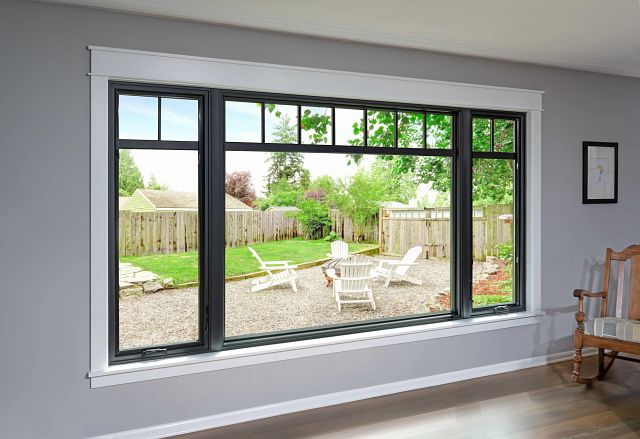
Picture windows are fixed — they don’t open. They maximize natural light, provide unobstructed views, and are the least expensive window per square foot because there’s no operating hardware. They’re often paired with flanking casements in living room configurations.
For large picture windows (48″ × 60″ or larger), cost scales with glass area. Premium sizes: $900–$1,800 installed.
Bay & Bow Windows — $2,500 to $7,500 installed
Bay windows project outward from the home’s exterior wall, creating a nook inside. Bow windows are similar but with a curved profile (typically 4–6 units). Both require structural work — a header above the opening must carry the load previously managed by the original wall area — which is where the cost increase comes from.
Bay window installations almost always include framing, exterior cladding, roof (small), and interior finishing. David Reno handles all structural work for bay and bow installations — including the permit and structural elements, not just the window unit.
Egress Windows (Basement) — $1,500 to $5,000 installed
Egress windows are larger basement windows that meet Ontario Building Code requirements for emergency egress from below-grade living spaces. They’re required in any basement bedroom or sleeping area, and are increasingly requested as Toronto homeowners finish basements for in-law suites.
The cost includes well excavation (digging out the exterior soil to create a window well), structural lintel work to enlarge the opening, window installation, and window well installation. A City of Toronto building permit is required for egress window installation.
Frame Materials: Vinyl, Fiberglass & Wood
| Frame Material | Cost Premium | Lifespan | Maintenance | Best For |
|---|---|---|---|---|
| Vinyl (uPVC) | Base price | 20–30 years | Very low — wash only | Most Toronto homes — best value |
| Fiberglass | +60–65% over vinyl | 30–50 years | Very low — no painting | Heritage homes, high-humidity zones, long-term ownership |
| Wood | +40–80% over vinyl | 20–30 years (with maintenance) | High — painting/staining every 5–7 yrs | Heritage character areas (Annex, Rosedale, Forest Hill) |
| Wood-Clad (wood interior, aluminum exterior) | +80–120% over vinyl | 30–40 years | Low exterior, some interior maintenance | Premium homes combining aesthetics with durability |
Fiberglass frames cost approximately 60–65% more than vinyl on an installed basis. The premium is justified by superior durability, better thermal performance, and a lifespan of 30–50 years vs. 20–30 for vinyl. For heritage or high-humidity zones fiberglass is often recommended.
For most Toronto homeowners replacing windows in a standard detached or semi-detached home, high-quality vinyl is the right answer — it performs excellently in Ontario’s climate, requires no maintenance, and delivers strong energy efficiency at a competitive price.
Double Pane vs. Triple Pane: The Honest Comparison
The double vs. triple pane decision is the most common question Toronto homeowners ask when replacing windows. Here’s an honest breakdown based on 2026 Toronto pricing and performance data.
| Double Pane (Low-E + Argon) | Triple Pane (Low-E + Argon) | |
|---|---|---|
| Glass layers | 2 panes, 1 air space | 3 panes, 2 air spaces |
| R-value (insulation) | R-3 to R-5 | R-5 to R-8 |
| U-factor (heat loss) | 0.25 – 0.30 | 0.15 – 0.22 |
| Condensation in cold weather | Possible in extreme cold | Significantly reduced |
| Sound reduction | Good (STC 28–32) | Better (STC 31–36) |
| Cost premium (Toronto, per window) | Base price | +$150 – $300 per window |
| Weight | Standard | 15–20% heavier — hardware must support |
| Energy payback period | N/A (baseline) | 5–10 years vs. double pane |
When Triple Pane Is Worth It in Toronto
- Homes on busy roads or near rail lines: The extra sound reduction is immediately noticeable
- North-facing or wind-exposed windows: Highest heat loss locations benefit most from triple pane’s lower U-factor
- Older, poorly insulated homes: If your walls have minimal insulation, upgrading windows to triple pane reduces heat loss more meaningfully
- Long-term ownership (10+ years): The energy payback justifies the premium over time
When Double Pane Is Sufficient
- Well-insulated modern homes in sheltered locations: High-quality double pane performs excellently
- Shorter ownership horizons (5–8 years): Payback period for triple pane may not be reached
- Budget-constrained projects: Replacing all 17 windows in double pane is better than replacing only 10 in triple pane
Energy Star, Low-E & Argon — What They Mean
Energy Star Certification
Energy Star is a government-backed certification standard. For windows in Ontario (Climate Zone 3), Energy Star requires a maximum U-factor of 1.22 W/m²K (approximately U-0.21 in imperial) and a minimum Energy Rating (ER) of 34.
Why it matters: Energy Star certification is the qualifying standard for Ontario’s active rebate programs. Only Energy Star certified windows make you eligible for the $100-per-window Ontario Home Renovation Savings Program rebate. Always confirm Energy Star certification before purchase — not all windows marketed as “energy efficient” meet the Ontario zone standard.
Low-E Coating
Low-emissivity (Low-E) coating is a microscopically thin metallic layer applied to the glass surface. It reflects radiant heat back into your home in winter and blocks solar heat gain in summer. Low-E coatings are standard on virtually all modern vinyl windows and typically add $30–$75 per window compared to uncoated glass. In 2026, any window without Low-E is a window you shouldn’t be buying.
Argon Gas Fill
Argon gas is injected into the sealed space between panes. It has lower thermal conductivity than air — meaning it slows heat transfer across the space between glass layers. Combined with Low-E, argon fill improves a window’s overall energy performance by 10–15%. Like Low-E, argon fill is now standard on mid-range and above windows — confirm it’s included in your specification, not an extra.
Retrofit vs. Full-Frame Installation
There are two ways to install replacement windows. The difference affects both cost and the final result.
| Retrofit (Insert) Installation | Full-Frame Installation | |
|---|---|---|
| What it involves | New window unit slides into existing frame | Existing frame completely removed, new frame installed |
| Cost | Lower — less labour and material | Higher (+$150–$500 per window) — full framing work |
| Glass area | Slightly reduced — new frame sits inside old frame | Full original opening — maximum glass area |
| When required | When existing frame is structurally sound | When frame is rotted, damaged, or wrong size |
| Exterior disturbance | Minimal — no exterior cladding work | Requires exterior wrap, cladding repair |
| Interior disturbance | Minor trim work only | Full interior trim replacement |
| Best for | Standard replacement in well-maintained frames | Older Toronto homes with wood frame rot, size changes |
Whole-Home Project Cost Examples
A typical 3-bedroom Toronto home has about 17 windows. At standard vinyl, double-pane, retrofit pricing with the GTA labour premium applied, expect $12,800–$17,400 all-in for the full house (2026).
Small Toronto Home — 10–12 Windows (Typical Semi-Detached)
- Double-pane vinyl, retrofit: $7,500 – $13,000
- Triple-pane vinyl, retrofit: $9,000 – $15,500
- Fiberglass, double-pane, retrofit: $12,000 – $21,000
Standard Toronto Home — 15–18 Windows (Detached, 3 Bedroom)
- Double-pane vinyl, retrofit: $11,000 – $18,500
- Triple-pane vinyl, retrofit: $13,500 – $22,000
- Fiberglass, triple-pane, retrofit: $18,000 – $29,000
- Add egress window (1): +$2,000 – $4,500
- Add bay window (1, replacing existing): +$2,500 – $5,500
Larger Toronto Home — 20–25 Windows (Detached, 4 Bedroom)
- Double-pane vinyl, full retrofit: $14,000 – $25,000
- Triple-pane vinyl, full retrofit: $17,500 – $29,000
- Full-frame replacement (where frames need replacement): +20–30% above retrofit pricing
Ontario Window Rebates 2026: What’s Active, What’s Closed
The rebate landscape for Ontario window replacement has changed significantly since 2023. Several programs that still appear prominently in search results are now closed. Here is an accurate picture of what you can actually claim in 2026.
✅ ACTIVE — Ontario Home Renovation Savings Program
Ontario’s Home Renovation Savings Program is active, open to new applications, and most homeowners replacing windows right now qualify for it. This is the primary window rebate program available in Ontario in 2026.
- Rebate amount: $100 per Energy Star certified window installed
- Who qualifies: Ontario homeowners installing Energy Star certified windows
- Pre-assessment required? No — simpler process than previous federal programs
- How to claim: Apply through the province’s process after installation is complete
- Example: Replace 15 windows = $1,500 rebate
Important: Windows must be Energy Star certified for Ontario’s climate zone. Confirm certification with your contractor before purchase.
✅ ACTIVE — Enbridge Gas Home Efficiency Rebate (HER)
Starting from July 15, 2024, Enbridge Gas customers can receive a maximum of $5,000 in rebates for qualifying energy-efficient upgrades including windows. To qualify, homeowners must complete a minimum of two eligible upgrades and a pre-retrofit home energy assessment.
- Maximum rebate: Up to $5,000 total (including $600 rebate for the EnerGuide assessment)
- Who qualifies: Enbridge Gas customers only
- Pre-assessment required? Yes — a Registered Energy Advisor must complete a home energy assessment before work begins. You cannot apply retroactively.
- Minimum upgrades: At least two eligible upgrades required (e.g. windows + insulation)
- Program note: Enbridge HER is designed for holistic retrofits — you’ll get more back if you combine windows with attic insulation, door replacement, or other building envelope improvements
❌ CLOSED — Programs No Longer Accepting Applications
Several previously well-publicized programs are now closed. Contractors still marketing these as available may be using outdated information — verify before making purchasing decisions based on rebate assumptions.
- Canada Greener Homes Grant: Closed to new applications. Applications submitted before December 31, 2025 are still being processed.
- Canada Greener Homes Loan (0% interest): Ended October 1, 2025.
- Enbridge Home Efficiency Rebate Plus (HER+): Closed since February 2024. It still shows up in outdated blog posts and contractor marketing. If a contractor quotes a price that assumes HER+ rebates, ask for clarification.
Stacking Your Rebates
The most effective approach in 2026: combine the Ontario Home Renovation Savings Program ($100/window) with the Enbridge HER (if you’re an Enbridge customer and planning two or more envelope upgrades). On a 15-window project combined with attic insulation, a homeowner might receive:
- HRSP: $1,500 (15 × $100)
- Enbridge HER (windows + insulation): up to $2,000–$3,000
- Total potential savings: $3,500–$4,500 on a project that might cost $14,000–$18,000
Factors That Affect Your Total Cost
1. Number of Windows
More windows = lower cost per window (volume discount, single mobilization). Replacing 5 windows costs more per window than replacing 17. If 12 of your 17 windows need replacement, consider replacing all 17 together.
2. Frame Condition
Hidden frame rot — particularly in older Toronto wood-frame homes — is discovered during installation. Budget $200–$500 per window for frame repairs if your home is pre-1990 construction. Get a written quote that addresses how frame damage is handled — per-window pricing or included.
3. Window Size & Style
Larger glass area = more material cost. Bay windows, large picture windows, and egress windows cost significantly more than standard casements. Custom sizes or shapes (arched, circular) add lead time and fabrication cost.
4. Interior Trim Conditions
Full-frame installations require interior trim replacement. If existing trim is custom millwork (common in older Toronto heritage homes), matching it exactly adds cost. Standard profile trim: $15–$30/linear foot. Custom heritage matching: $40–$80/linear foot.
5. Exterior Cladding
Full-frame replacement may require exterior work — replacing the casing, brick moulding, or wrap. On brick homes (very common in Toronto), the interface between new window and existing brick requires careful caulking and flashing to prevent water infiltration.
6. Lead Time for Specialty Windows
In 2026, specialty windows may require six to twelve weeks of lead time. Standard vinyl casements are typically 3–4 weeks. If you’re replacing before winter, order by September at the latest for October installation.
Installation Timeline
| Phase | Duration | What Happens |
|---|---|---|
| On-site estimate & measurement | 1 visit (1–2 hrs) | Every window measured precisely; frame condition assessed; rebate eligibility confirmed |
| EnerGuide assessment (if Enbridge HER) | 1 visit, book 1–2 weeks in advance | Must be completed before installation for rebate eligibility |
| Window order & fabrication | 3–8 weeks | Custom-measured windows manufactured; standard vinyl fastest, fiberglass/specialty longer |
| Installation | 1–3 days (typical home) | Old windows removed, new windows installed, interior and exterior trim, caulking |
| Interior finishing | Half to 1 day | Touch-up painting, trim painting, final caulk inspection |
| Rebate application | After completion | HRSP applied online. Enbridge HER submitted by Registered Energy Advisor. |
Total timeline: From first call to completed installation, allow 4–10 weeks. Booking in August for September or October installation is ideal — windows are sealed before the heating season, and installation weather is cooperative.
How David Reno Can Help
Window replacement is a core part of David Reno’s home renovation services — not a sideline. We handle complete window installations across Toronto and the GTA, bringing the same commitment to quality and permit compliance that we apply to every renovation project.
What David Reno handles on every window project:
- On-site assessment & measurement: We measure every window precisely and assess frame condition — frame rot discovered during installation is documented in the quote, not added as a surprise
- Product specification: We specify Energy Star certified windows with Low-E and argon as a minimum — ensuring rebate eligibility and climate-appropriate performance
- Double vs. triple pane recommendation: We make site-specific recommendations based on window orientation, noise exposure, and your timeline — not a one-size answer
- Old window removal & disposal: Removed windows are properly disposed of — no charge surprises
- Retrofit or full-frame installation: We handle both methods — full-frame when frame condition warrants it
- Interior trim: Trim removed and reinstalled (or replaced if damaged) — finished room, not a construction site
- Exterior sealing & flashing: Proper weatherproof sealing on Toronto’s brick and siding homes — no gaps that allow water or air infiltration
- Permit management (egress & bay windows): We pull permits and manage inspections for any window project that requires them
- Rebate guidance: We confirm Energy Star certification, advise on rebate timing, and provide the documentation you need to submit your HRSP claim
- Written warranty: All David Reno installation work is warranted in writing
Tips to Save Money on Window Replacement
1. Replace All Windows at Once
Whole-house projects often attract a 10–15% volume discount per window vs. piecemeal replacement. If most of your windows are aging, replacing all of them in one project is almost always cheaper per window — and avoids multiple mobilizations and installation visits over several years.
2. Book for Fall Installation
Schedule your window installation in late autumn or early winter. Off-season demand drops, wait times shorten, and many installers offer 10–20% discounts to keep their crews busy. September and October are ideal: weather cooperates, and your home is sealed before the heating season.
3. Get the EnerGuide Assessment Before Starting
If you’re an Enbridge Gas customer and planning to combine windows with attic insulation or other upgrades, book your EnerGuide assessment before any work begins. This unlocks the Enbridge HER rebate — potentially $2,000–$3,000 on a combined project. You cannot apply retroactively after installation.
4. Don’t Over-Specify for Your Home
Fiberglass windows are the right choice for heritage homes and high-humidity zones. For a standard 1970s detached in North York or Etobicoke, high-quality vinyl performs excellently. Upgrading to fiberglass when vinyl is appropriate adds 60–65% to your window cost without a proportional performance benefit.
5. Start with the Worst-Performing Windows
If budget constrains a full replacement, prioritize north-facing windows (most heat loss), basement windows (moisture damage risk), and any window with visible condensation between panes (already failed thermally). South and east-facing windows in good condition can wait.
6. Confirm Energy Star Before Purchase
Only Energy Star certified windows qualify for the $100/window HRSP rebate. Some windows are marketed as “energy efficient” without meeting the certification standard. Ask for the Energy Star certification number — not just the label.
Frequently Asked Questions
How much does window replacement cost in Toronto in 2026?
Window replacement in the GTA costs $700–$1,300 fully installed per standard vinyl casement window in 2026. Triple-pane upgrades add roughly $150–$300 per window. A typical 3-bedroom Toronto home (17 windows) costs $12,800–$17,400 all-in for double-pane vinyl, or $15,000–$22,000 for triple-pane. Toronto carries a 15–25% labour premium over the rest of Ontario.
Is triple pane worth it in Toronto?
For most Toronto homeowners in 2026, yes. The price premium over double-pane has narrowed to roughly $120–$180 per window, making the long-term energy payback compelling for most homeowners. Triple pane reduces heat loss in Ontario winters, eliminates most condensation on cold days, and meaningfully reduces exterior noise — particularly valuable on busy streets or near transit lines. For a well-insulated home in a sheltered location, high-quality double pane with Low-E and argon is still a very solid choice.
What rebates are available for window replacement in Ontario in 2026?
The two active programs in 2026 are the Ontario Home Renovation Savings Program ($100 per Energy Star window, no pre-assessment required) and the Enbridge Gas Home Efficiency Rebate (up to $5,000 for Enbridge customers who complete a pre-retrofit EnerGuide assessment and at least two eligible upgrades). The Canada Greener Homes Grant, the Greener Homes Loan, and the Enbridge HER+ are all closed to new applicants. Always verify program status before assuming a rebate is available.
Do I need a permit to replace windows in Toronto?
A building permit is generally not required for like-for-like window replacement — same size, same location, retrofit installation — in Toronto. A permit is required if you are enlarging an existing opening, creating a new window opening, installing an egress window (which requires structural work), or replacing a window that involves structural changes. David Reno reviews permit requirements at the estimate visit for every project.
How long does window replacement take?
A typical Toronto home (12–18 windows) takes 1–3 days of installation. The lead time for window fabrication is 3–8 weeks depending on style and material — standard vinyl casements are fastest, fiberglass and specialty windows take longer. From first call to completed installation, allow 4–10 weeks total. Booking in August for September or October installation is ideal timing.
What’s the difference between retrofit and full-frame window installation?
Retrofit (insert) installation slides a new window unit into the existing frame — lower cost, less disruption, and appropriate when frames are structurally sound. Full-frame installation removes the existing frame completely and installs new framing — required when frames are rotted or damaged, or when you’re changing the window size. Full-frame costs $150–$500 more per window in labour and materials. David Reno assesses frame condition at the estimate visit and recommends the appropriate method — not the more expensive one by default.
Ready to Replace Your Windows Before Winter?
Don’t spend another Toronto winter paying to heat the outdoors. New Energy Star certified windows — double or triple pane — seal your home’s thermal envelope, eliminate drafts, and can meaningfully reduce your heating bill from October through April.
David Reno replaces windows across Toronto and the GTA with proper installation, Energy Star certified products, and full guidance on active rebate programs. We handle everything: measurement, removal, installation, trim, and exterior sealing.
We serve North York, Scarborough, Etobicoke, Leaside, The Annex, Roncesvalles, The Beach, Mississauga, Markham, and all of Toronto and the GTA.
🪟 Call us today: (647) 463-2246
📧 Email: info@davidreno.ca
📍 Serving all of Toronto & GTA
⚡ September and October installation slots fill quickly — call today to secure your pre-winter replacement date.